



One of the first background CGs to be completed for the NEEDY anime was this Mondrian-like room.
It’s an interior I’m deeply fond of—like a modern arrangement of the Rietveld Schröder House I visited in Utrecht.
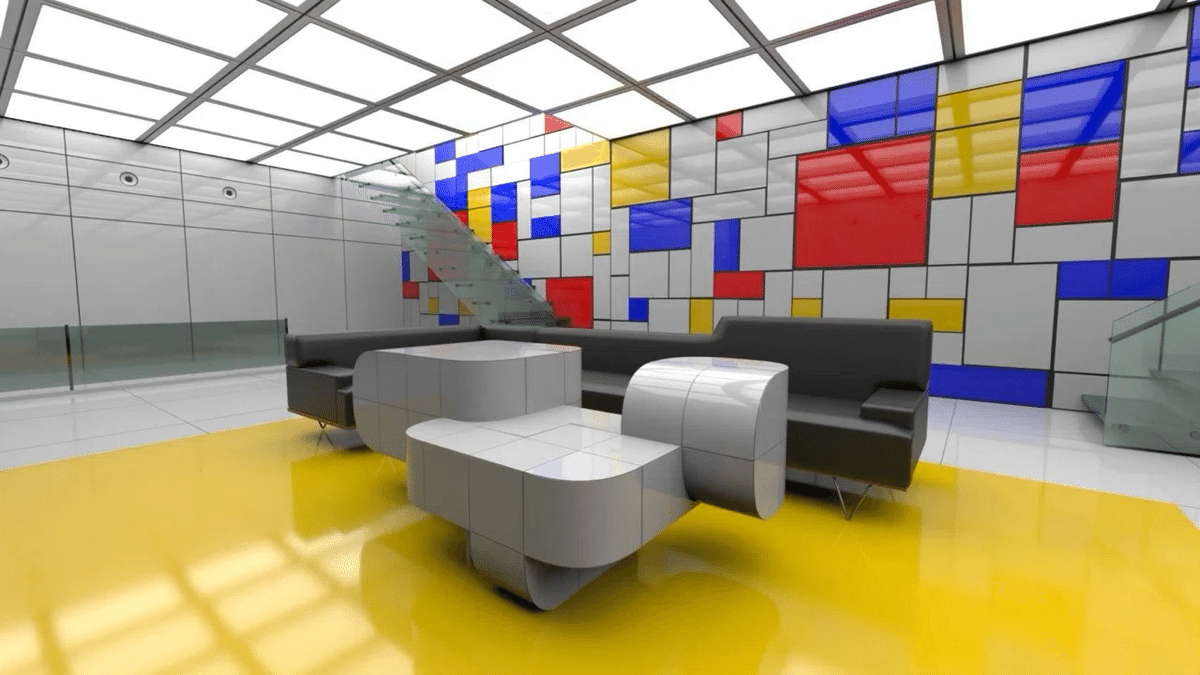
Mondrian’s tricolor of red, blue, and yellow. I’ve always wanted to challenge myself with the power of the three primary colors. It would be even better if I could express color as naturally as a Godard film does. If I’m going to create a visual work, I feel like the artistic pursuits I’ve chased all my life should come as part of the package.
People sometimes say the NEEDY anime feels “like (a classic anime from back in the day),” but the context is different. The direction is imagined through Kubrick and French cinema—more like inheriting the Kubrick-and-Godard gene that those older works themselves carried. Something Japan inherited by way of directors like Akio Jissoji (Ultraman).
I directed the PV for Karamazov!
I tried to pick up on nyalra’s love for Godard
and build it into the piece.
Please support both the theatrical version and the TV broadcast!
Art can be broken down into algorithms.
What becomes “artistic” is how you rearrange those “good elements,” or whether you can enjoy the results of chance. How do you step away from the bundle of algorithms that are generally considered “good”? Or, on the contrary, do you deliberately charge straight into the orthodox principle of pleasure? This fine-tuning of balance is what leads to total art.
One of my private joys in anime production is to admire the unexpected outputs born from that synthesis—to enjoy the accidental byproducts that emerge.
And with that, here’s a single frame from the PV we released the other day—one that moved me more than anyone else.

Because the character uses such a toxic, aggressive palette, a “purple” that would never appear in the original composition gets injected into the frame—and to me, the image becomes revolutionary.
This happened simply by layering a prepared character over a prepared background. Yet that purple—born from the mixing of red and blue—pushes itself to the front as if it were covering the vivid tricolor. It’s a result you wouldn’t get if you followed the usual “Mondrian-conscious” algorithm. I interpret the accumulation of these kinds of chemical reactions as art.
The artistry lies in making the viewer read into why it was born. An algorithm-made work simplifies that context too much.
What kind of thoughts and processes lead to a purple bishoujo being placed into this composition?
Thinking about things like that, I want to keep stepping further down the path of art—an thorny road that stands in opposition to God—one step at a time.
Comments (0)
Leave a comment
No comments yet. Be the first to comment!