


※This is a repost of an article originally published on May 20, 2023.
Lately, I’ve been listening again to bishoujo game songs from around 1998 to 2002. I tried to figure out what exactly it is about the songs from this period that strikes such a chord with me, and I came to the conclusion that it’s basically two things: the “straightforwardness of the lyrics” and the “synth sounds that still carry the influence of Tetsuya Komuro.”
Early eroge songs are astonishingly Komuro-esque. The presence of 2D bishoujo characters makes it hard to notice at first glance, but if you break them down, they become very Komuro. But that’s a whole tedious discussion, so I’ll leave it out. If I had to give you an example, though, try listening to Tomomi Kahala’s “I BELIEVE” with your eyes closed. You’ll see them, won’t you? The standing portraits of bishoujo characters appearing and disappearing alongside cryptic lines of dialogue. You might mistake it for the opening theme to some famous nakige, only the lyrics and music were written by Komuro.
Old bishoujo game songs have very straightforward lyrics. That’s because, back then, simply being able to “fall in love with a bishoujo character” was something special. These days, whether you’re watching anime or booting up a gacha game, you’re surrounded by bishoujo characters, and every single one of them absolutely adores you. When you’re that popular, even the otaku eventually gets tired of plain old romance. So the creators start making the stories more complicated and more epic. There’s nothing inherently wrong with that, of course.
Early bishoujo game, by contrast, basically started with “picking up girls.” Rather than an emotionally overwhelming scenario or an elaborate worldbuilding premise, the priority was more along the lines of “go on dates with the girl, raise her affection, and win her over.” Of course, there were countless games even back then that were elaborate in terms of gameplay or story, but as a general tendency, I think there were definitely more games with simpler structures than there are today. Even when they were set in SF or fantasy worlds, there were plenty with that light, poppy, Satoru Akahori-esque tone.
Naturally, the lyrics would end up being about love and romance. Because what actually happens in the game is basically just “the protagonist meets a bishoujo, listens to her troubles like a counselor, helps her work through them, and eventually starts dating her.” So the things you have to say tend to become vague, pretty platitudes like “If we’re together, we can surely overcome anything” or “I can’t stop these bittersweet feelings.” Then you layer an otaku-tuned Komuro sound and a wistful female vocalist on top of that, and voilà: the ’90s are complete. Lyrics that sound like they’re saying something profound in that very J-pop way are important. There’s something about the way they’re fluffy yet completely unjaded that makes them seem pure and, somehow, precious. It’s hard to deliberately recreate that feeling today. Isn’t that the appeal of retro eroge songs?
Eventually, the wave of nakige arrived and the genre began to mature. Before long, the darkness and secrets carried by the girls and their worlds grew larger and larger, while the stories became increasingly literary, eventually reaching the height of their popularity. By this point, they had escaped the Komuro sound—the ghost of the ’90s—and the lyrics could no longer be summed up with words like “love” and “miracles.” We weren’t living in the age of picking up girls and going on dates anymore. We’d reached the level of manipulated destinies and causality and all that. There was no way we were still interested in something as primitive as selecting the command to call a girl on the phone and then systematically trying every present and date spot to see what she liked.
And yet, here in the Reiwa era, I happened to watch an episode of Kochikame featuring Sakonji that was being streamed.
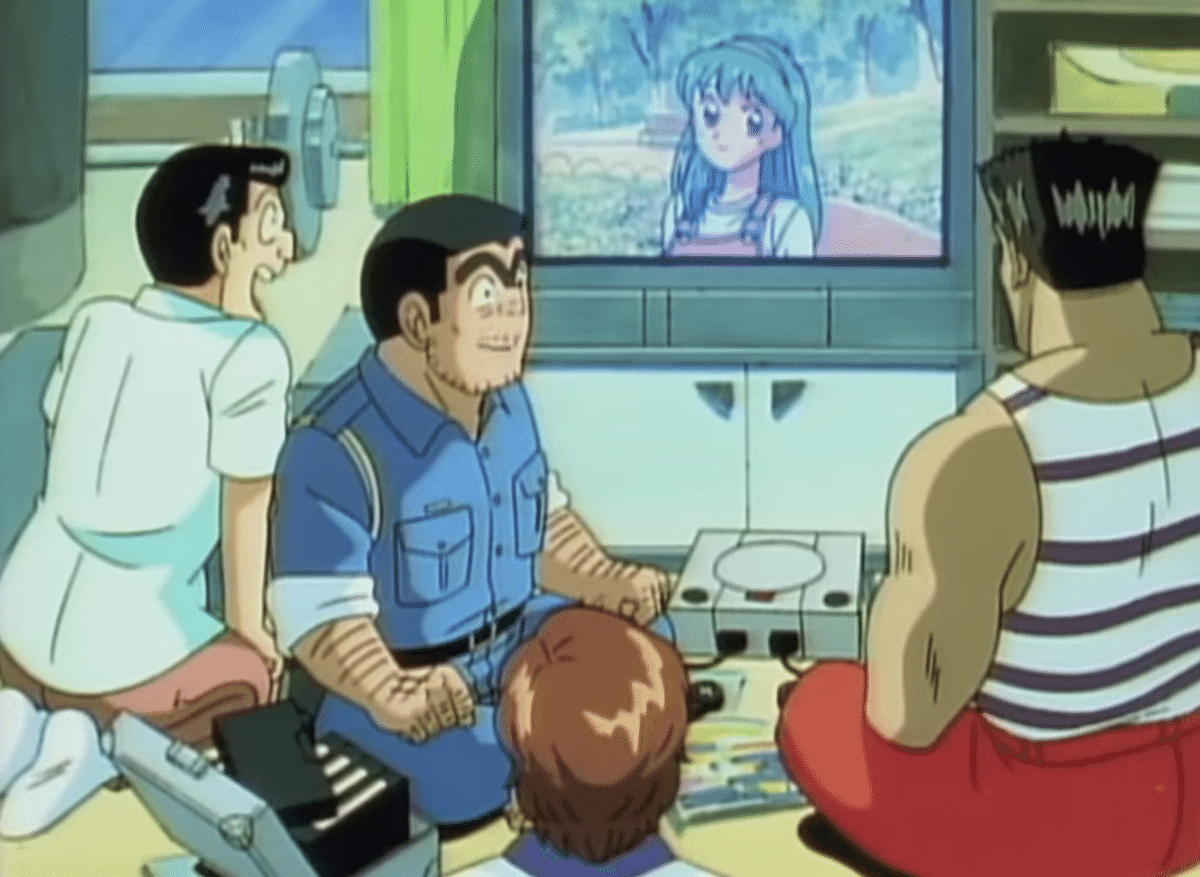
What a wonderful image. A cramped, filthy bachelor dorm packed with sweaty single men. Sakonji completely obsessed with Saori, the bishoujo girl on the other side of the screen. Having never had any luck with women, he puts everything he has into the existence of “a girl who will call him by his name and go on a date with him.” He swallows his pride and asks Ryotsu for advice on how to romance her, and even studies the female psyche by watching Nakagawa, who is popular with women. The game, which is based on Tokimeki Memorial, has no deep scenario. Everything comes down to how well you can keep Saori in a good mood. In a sense, that’s the ultimate form of realism. Because most human relationships are built simply by interacting with someone again and again and gradually becoming closer. As his romance advice, Ryotsu tells him to be kind to the girls who aren’t his target as well, because otherwise his reputation will suffer. And that, too, is perfectly sound advice when it comes to human relationships. Once you overcome that monotonous reality, you arrive at dates and confessions. At the reward of having the beautiful girl you’ve always admired call you by your name.
That’s it. That’s the entire reward. And yet, with just that much, Sakonji gets more excited and more deeply moved than he has been by almost anything else in his life. It’s wonderful. No one is more devoted to his heroine. He thinks about her constantly, carefully considering what would make her happy before making each choice. Even that alone is an incredible thing. Because these 2D bishoujo characters actually care about us hopeless otaku. A flower on a distant, unreachable peak turns to you for help and calls you by name. It’s a primal joy, a sense of validation that you could never experience in the real world.
We need to face them. We need to approach each and every one of these oversaturated bishoujo characters with greater sincerity and seriousness. Where should we take her to make her happy? What could we say that would make her sad? What stats should we work on to make her attracted to us? We, too, need to construct our own strategies for romance Saori, just as Sakonji and Ryotsu painstakingly studied her. We need to see the heroine not as a character, but as a “human being” standing right in front of us. That’s the philosophy behind the game I made, where you simply continue living together with the heroine……
That said, for all the old-school otaku like Sakonji out there, I think Honda is the truly incredible one: he went to Akihabara, loudly talked about late-night anime, slapped moe stickers all over his motorcycle, fully embraced the stereotypical young otaku lifestyle, and even managed to rise to a position where he knew more about moe culture than Ryotsu himself.
Comments (0)
Leave a comment
No comments yet. Be the first to comment!