


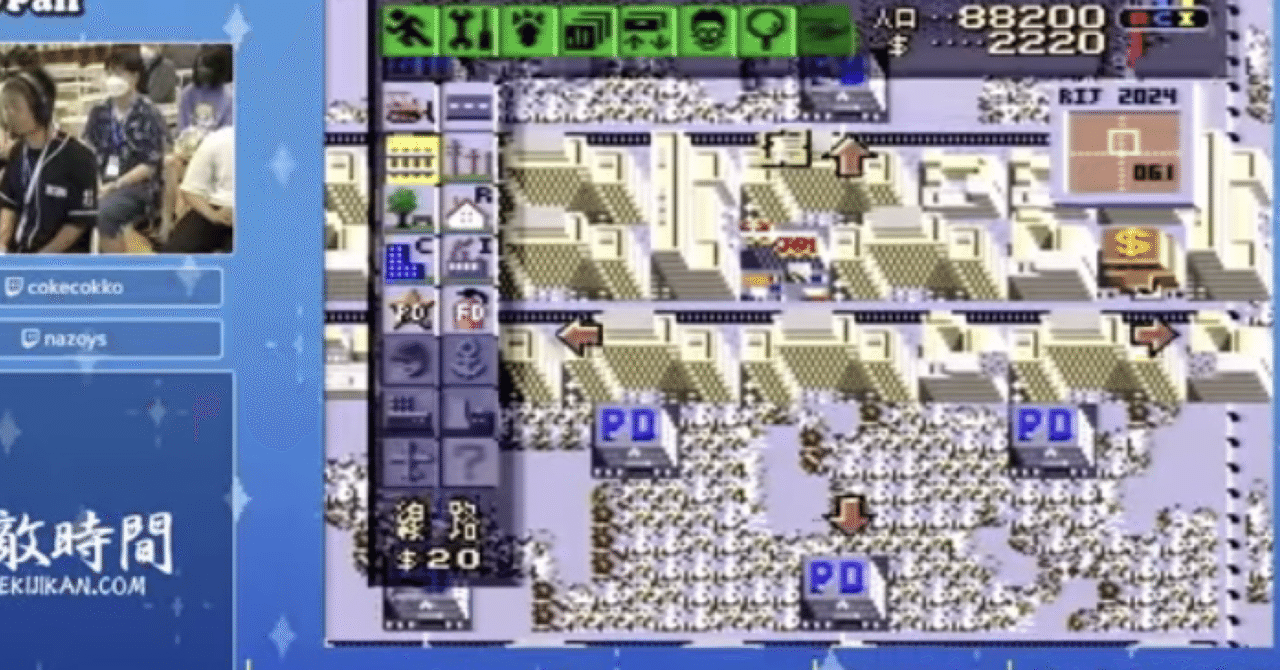
I've been completely hooked on the SimCity run from RTA in Japan. Not just once—I keep leaving it on in the background over and over. Watching the "correct answer" to a game I love unfold before my eyes, seeing an optimized playthrough where every action serves a purpose, and watching the numbers rise and fall with such satisfying rhythm... it's simply exhilarating.
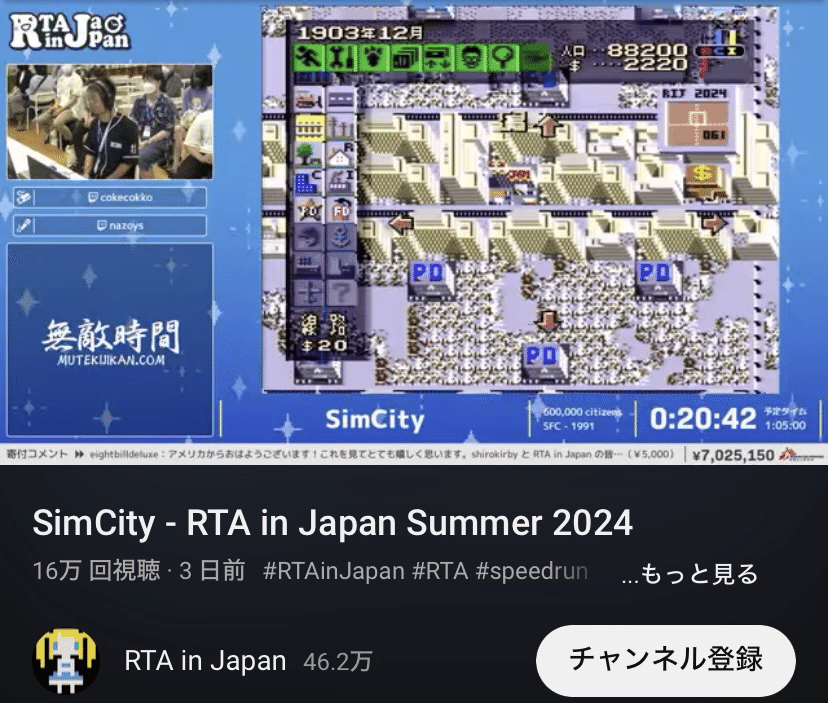
The commentary is peppered with bits of humor: jokes about a mayor constantly raising taxes, quips about hospitals and schools being demolished one after another while comparing it to the real-world decline of public facilities. By drawing these parallels to reality, the commentators highlight just how astonishing SimCity is as a simulation. The city truly feels like a living organism, and you can sense that's exactly what the developers intended. It's genuinely moving.
The Super Famicom version of SimCity was such a massive hit that countless strategies have been discovered over the years. But those strategies aren't just ways to beat a game—they're lessons in how society itself functions.
Build leisure facilities to raise residential land value. But if you build too many flashy attractions, you'll need police stations nearby to keep crime under control. The placement of industrial zones, commercial districts, roads, and railways all matter, and the game teaches you the most efficient ways to lay them out. Just by playing, you begin to understand the purpose of each kind of facility in the real world and how they relate to one another. That's exactly how I felt when I first played it on the Wii Virtual Console: "So this is how cities actually work!"
In the RTA, the player immediately raises taxes to the maximum in order to build up funds. Even with sky-high taxes, as long as land values continue to rise, the city somehow survives. Then, once population growth begins to stagnate, taxes are dramatically lowered to attract new residents. That's an enormous simplification, of course, but using this strategy they build a metropolis of 600,000 people in roughly an hour.
I honestly think SimCity might be the best game ever made for teaching children how taxes work. Taxes are necessary to improve a city, but if they're too high, people become unhappy—even if it's supposedly "for their own good." At the same time, those tax revenues have to pay for police stations, fire departments, and countless other public services. It's a masterpiece because it lets you experience these systems firsthand instead of simply reading about them. According to the commentators, some municipalities have even used SimCity as an educational tool in schools. Wonderful. There's no way little brats like we were could have grasped the complexity of society just by reading a civics textbook.
On top of that, it delivers the kind of wonderfully obsessive commentary you'd expect from RTA in Japan.
For example, one of the oldest pieces of SimCity strategy has always been: "Because you're population won't grow, immediately demolish your hospitals". Even I vaguely knew that as a kid playing the Wii Virtual Console version. It was probably the very first thing any veteran player would bring up whenever SimCity came up in conversation.
This runner, however, carefully explained where that idea actually came from. He bought the three strategy guides that were considered the definitive SimCity guides at the time, and confirmed that every single one of them literally said, "Demolish your hospitals!" Naturally, everyone came away believing, "Hospitals and schools are useless in this game."
But that's only half the story. Once you meet certain conditions, the game rewards you with special landmark buildings. One of those conditions is having built a sufficient number of hospitals and schools. Until you've unlocked those rewards, you absolutely do need to build them. After that point, the strategy guides are correct: hospitals and schools no longer contribute to population growth, so demolishing them becomes optimal. But because that important explanation was omitted, all that survived was the rather violent rule of thumb: "Just demolish the hospitals." Seeing the history untangled like this reminded me that even I had remembered only the simplified version. Games really are fascinating.
Without exaggeration, there are countless things I never would have understood if not for SimCity. It taught me so much. Nobunaga's Ambition taught me quite a bit, too.
By wrapping educational concepts in fast-paced, humorous gameplay and presenting them as engaging systems, SimCity reveals the appeal of all those mysterious jobs adults do. It's remarkable. In a sense, watching a SimCity speedrun feels like watching a speedrun of society itself.
Makes you want to double everyone's taxes and suddenly build police stations all over the place in real life, doesn't it?
Comments (0)
Leave a comment
No comments yet. Be the first to comment!