


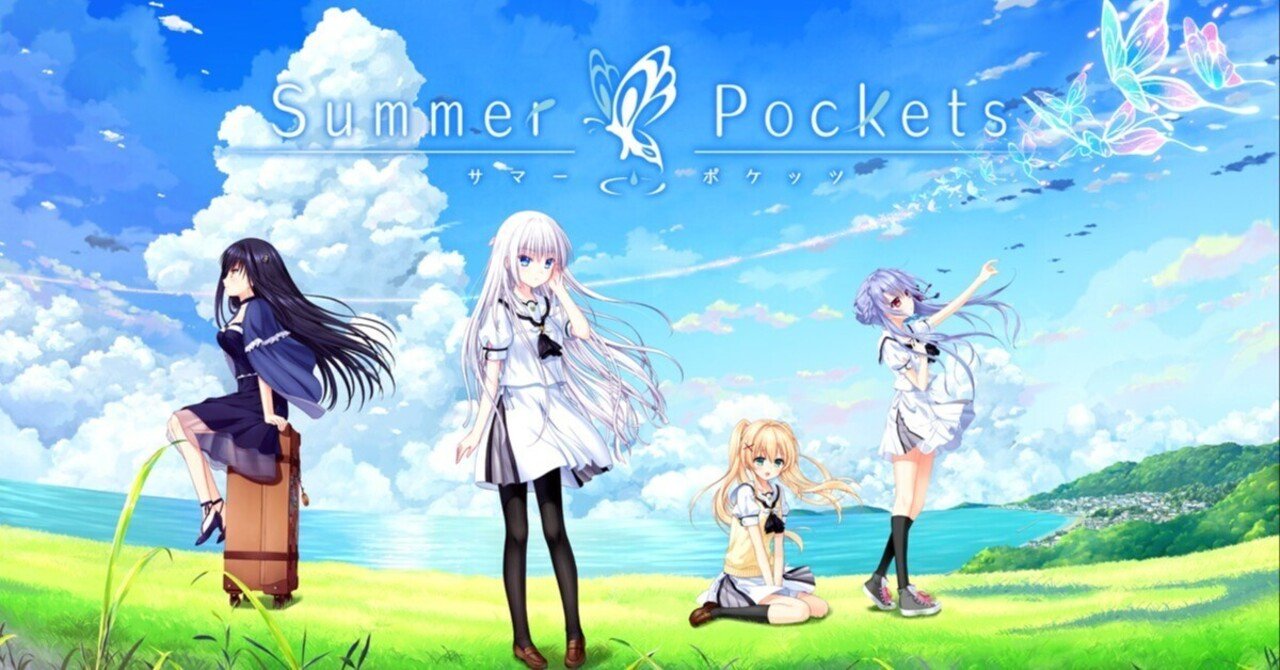
※This is something I originally wrote for a doujinshi a few years ago.
Since Kaginado aired and all, and even though summer has already passed, I thought I might talk a little about what I love in Summer Pockets.
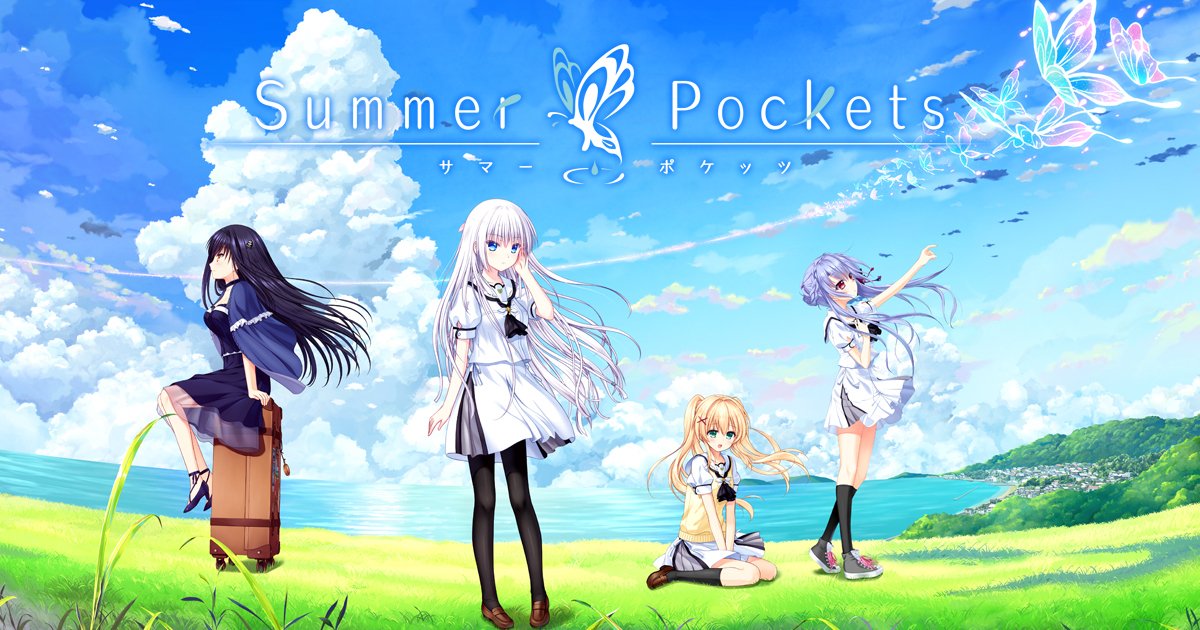
Summer Pockets is a story about spending a quiet summer on an island. There, you meet all kinds of people: mysterious ones, kind ones who are a little goofy, strangely timid ones, ones overflowing with eros, and even perverted bad-friend types. Written out like that, it might remind you of AIR, but what was so good about it was how straightforwardly it committed to that classic setup: forgetting the noise of the city and spending summer on an island with beautiful girls.
“Summer,” “an island,” “beautiful girls” — these are all things that can’t help but make you excited. And instead of twisting that into something strange, a major studio simply delivered exactly what people wanted, with high quality and with gimmicks that still managed to go beyond expectations. As a whole, it was a very satisfying game to play.
My favorite scene is when one of the heroines, Tsumugi, talks about the things she wants the two of them to do together someday. In the middle of that, she says, “Someday, I want us to go on a date off the island, and go shopping together at a convenience store in the middle of the night.” And that part is just… so good.
In Key’s world, where all kinds of miracles and magic happen, suddenly this utterly life-sized image bursts in: the happiness of an ordinary couple going to a convenience store together late at night. It’s not some anime-esque big event like Halloween or Christmas. It hits you with something that could really happen — the two of you going out shopping at night, flirting just a little. That’s the part that stayed with me most.
Even these Key heroines, who bring about unreal and grand experiences and emotions, still long for something as simple as the happiness of going to a convenience store late at night with the person they love. Isn’t that wonderful…?
As an aside, let me talk about Jun Maeda. Because of health problems and hospitalization, he was involved at the planning stage, but wasn’t able to participate as a scenario writer.

After making a full recovery, Jun Maeda turned not to bishoujo games this time, but to literature. The result was Neko Gari Zoku no Osa (The Chief of the Cat-Hunting Tribe). published by Kodansha.
That book, too, is sharply divisive. But as a story, it’s about an ordinary female college student desperately trying to stop the suicidal impulses of a genius female composer. The composer is highly regarded and well provided for by society, but she carries with her a vague death wish that even psychiatry cannot truly understand. And when it comes to that desire to die, no matter what anyone says, no one can talk it away.
That setup is incredible.
Maeda said something like, “Up until now, I’ve been writing fiction. This is the first time I wrote what I truly think.” And I can’t help but feel that this urge toward death is exactly that — Maeda’s most honest truth. No matter how much the world, or people with more ordinary sensibilities, try to reach toward it, this kind of depression can never truly be empathized with. You can feel the determination in the work: the determination to write about that as its theme.
Unlike the “fiction” of Summer Pockets, this feels like “reality” — Jun Maeda throwing down what he really thinks. If you have the chance, I’d recommend experiencing both. The contrast between them might make for a really fascinating reading experience.
Comments (0)
Leave a comment
No comments yet. Be the first to comment!