


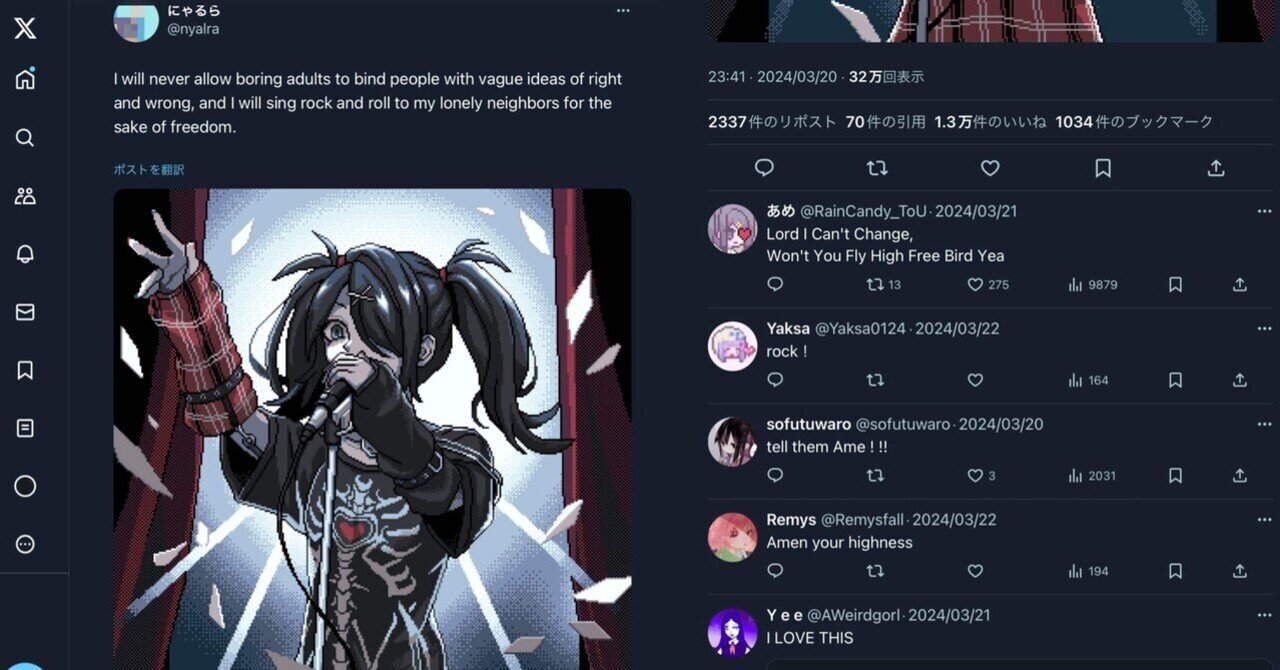
※This is a repost of an article originally published on note on April 12, 2024.
One of the biggest changes, two years after NSO, is that Ame-chan herself has been getting more popular. There are basically two reasons for it—though to explain them, I’m going to take the scenic route. A long, long story.
If you’re one of the weird readers who’s been following my diary pretty closely, you might’ve noticed: over the last year, I’ve started to settle into overseas culture more and more. I even had my first trip abroad. That’s a big change for me, personally.
People love to quote it—“The limits of my language mean the limits of my world.” It’s Wittgenstein, but through social media I’ve been feeling it in my bones: as language expands, your world expands with it.
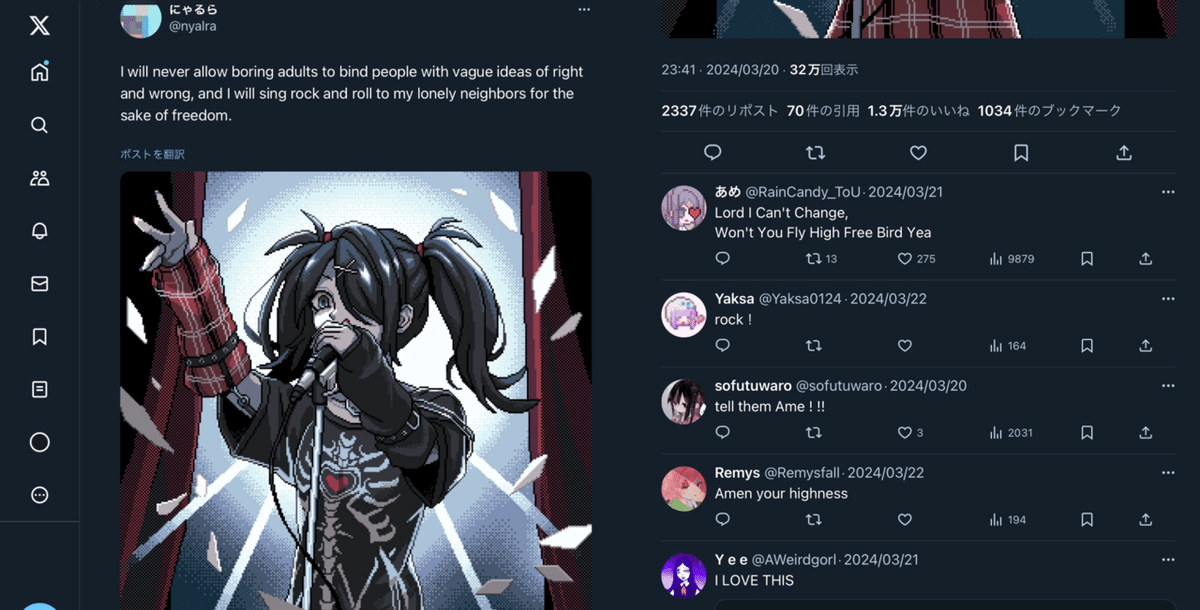
Because overseas fans have been supporting me so hard, I’ve started posting in English here and there, too. And every time I do, people in the English-speaking world react. If you keep doing that, you start to see what people in each country like, how they like it—and you start to feel what Japan shares with them, and what’s decisively different.
There’s no study method more efficient than “feeling it in your skin.”
At this point, even if I tweet in Japanese, I still get replies from tons of people overseas (honestly, sometimes it feels like there are more overseas fans, because the ones who cross the ocean tend to have that extra level of passion). And as I read through all of it, I’ve started to take an interest in English in a way that honestly shocks me—because back in school, I did everything I could to avoid it.
NSO’s popularity (outside Japan) first caught fire in China and Korea, but right now the English-speaking side has the highest heat. It spreads through nearby Asia first, and then it turns into a boom in the English-speaking world—Japanese culture tends to propagate in that kind of path, and my own work ended up following it too. So now we’re at the stage where it’s fully reached the English-speaking world.
And by the way—fans in China/Korea and in the English-speaking world are still increasing, even now. KAngel really is insane. I want to show her the view from two million copies somehow, within the year.
Anyway.
There’s a particular set of English-speaking culture that I’m interested in on a core, gut-level aesthetic basis: goth, punk, and emo fashion.
It all basically gets bundled into “Marilyn Manson,” but still.
My adolescence got destroyed by Manson and Rozen Maiden, so gothic aesthetics are basically the foundation of my sense of beauty. To put it bluntly, I judge most things purely on “cool” vs “not cool.” And because the origin of that “cool” is the real deal—the homeland—I’ve always had my attention there.
And then, through fans, I started learning about their culture and their everyday lives. I began to feel like maybe I could jump into English-speaking spaces without flinching, so I started actively reading overseas articles and forums, too.
And it’s like… it’s so fun.
When you follow goth stuff, or cartoon stuff, you can feel the difference from Japan immediately—different perspectives, different intensity. For them, fashion is literally a way of life, so the pressure is different. Even just reading the arguments over whether goth “went mainstream” because of Wednesday’s influence is endlessly entertaining.
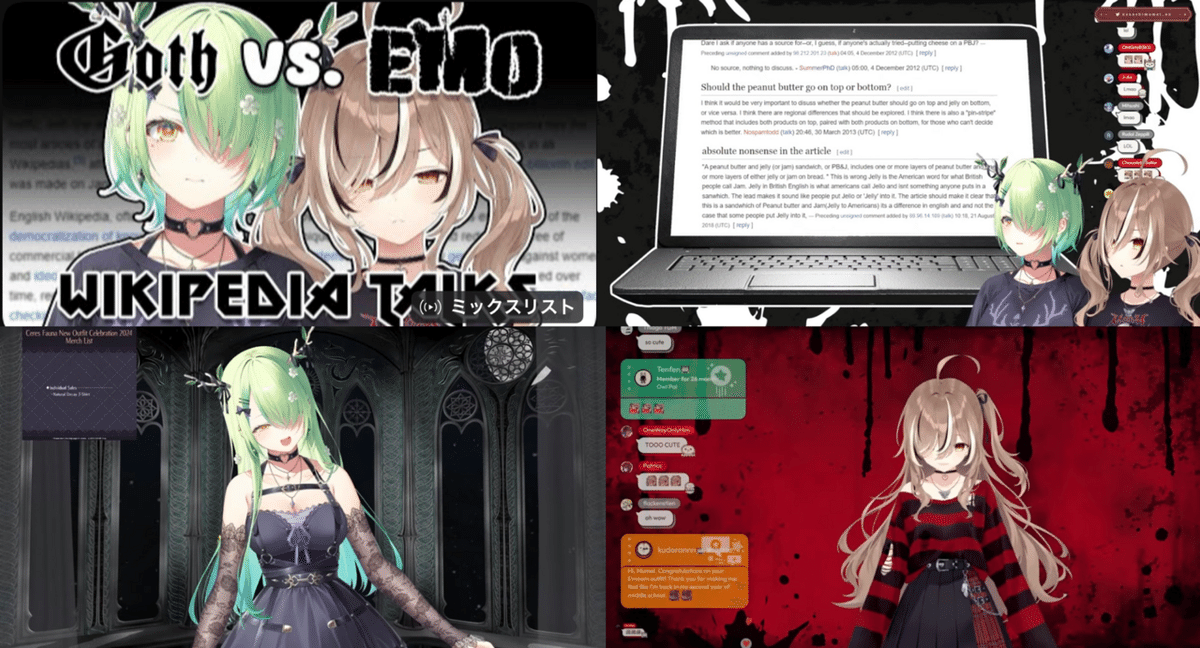
There was also a really clear example right after the HoloEN new-outfit reveals: Fauna as Goth, Mumei as Emo. It’s such a good idea because you can see the “close-but-far” difference between goth and emo. And on top of that, they actually debated it—goth side vs emo side—while referencing Wikipedia.
I mean… I’m happy. Is it really okay for something this personally perfect to exist?
In Japan, you almost never see streams where people talk as representatives of fashion “types” like that. Probably because goth/emo point to a mindset more than just a look. And none of this stuff gets translated, so you just have to grit your teeth and keep listening.
But even being able to convert that high hurdle into something enjoyable—honestly, that’s also thanks to English starting to feel familiar through interacting with overseas fans.
thanks!
And because of those cultural differences, Ame-chan—who’s clearly goth/punk-coded—has especially strong popularity in the English-speaking world. She comes up a lot among goth girls. And as someone who’s carried “gothic” as a personal creed, that makes me happier than anything.
When Japan just wraps her up in one word—“menhera”—I get a little sad. Like, no… please look at her more.

Within Asia too, Ame-chan’s popularity has been rising—and you can see it clearly in merch.
Until now, KAngel (the flashy one) would inevitably sell like double, but now Ame-chan is getting bought at nearly the same level. Which means I can put out lots of merch of a black-clad ordinary girl.
Thank you.
It’s simple: the core userbase has grown. Because if you actually play the game, the character you spend the most time with is Ame-chan—she’s your partner, the one who shares time with you more than anyone else. The “I’ve only seen KAngel” layer has slowly peeled away, and over two years the core fans have formed.
I’ll repay that, properly, in the form of new projects.
Getting tossed around by the huge existence that is KAngel, going through every twist and turn, returning to Ame-chan, to goth and punk as a spirit—and on top of that, becoming someone who can touch overseas culture without resistance.
Through the expansion of language, my world—my limits of thought—have very clearly expanded.
And I’m sure the results of that will bear fruit in the next work and beyond. So keep watching my evolution from every angle.
Comments (2)
Leave a comment