


※This article is a repost of an article originally published about 10 years ago.
All over the internet, people argue about death in a thousand different ways.
So this time, I want to talk about Yukio Sumadera—one of those bishoujo game heroines who’s especially loaded with “death” as a theme.
There’s a bishoujo game called December When There Are No Angels (Tenshi no Inai 12-gatsu). It was released by the legendary Leaf, and it’s an ambitious work that lined up “ahead-of-its-time” heroine archetypes back when the whole menhera vibe wasn’t even widely named yet.
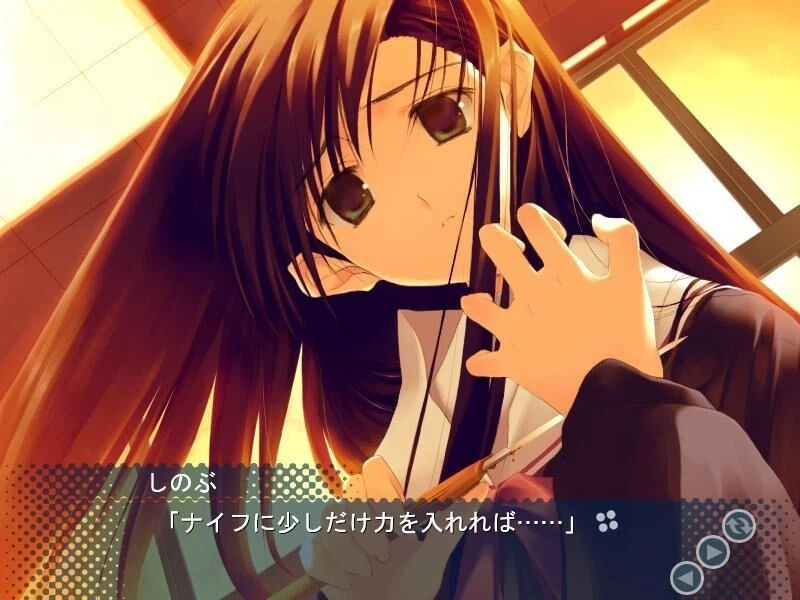
Out of all the extreme heroines in the game, let’s focus on the route of the one who feels the most “ahead of her era”: Yukio Sumadera
・Yukio Sumadera
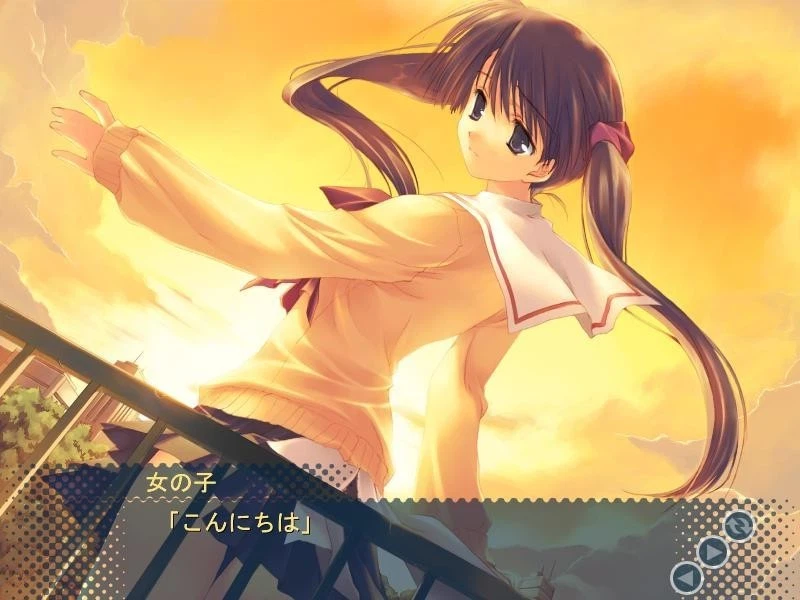
My first encounter with Sumadera starts on a rooftop at sundown.
The protagonist is the type who constantly cuts class, sneaks up to the roof, and smokes. And on this particular day, when he comes up for a quick hit, he runs into a beautiful girl who—by pure coincidence—looks like she’s about to step off the roof.
That rebellious “sneak onto the roof to smoke” adolescence vibe always makes me think of Taiyo Matsumoto’s Blue Spring.
The protagonist panics at the sight of her, but Sumadera stays perfectly calm and greets him with a casual, “Hello.”
In a more “bishoujo game protagonist” kind of world, he’d probably shoot back with something clever like, “Whoa, in your country you say ‘hello’ even at sunset?”
But this guy, despite acting like a cynical soft-delinquent, is bizarrely terrible under pressure—so he just freezes up and trembles.
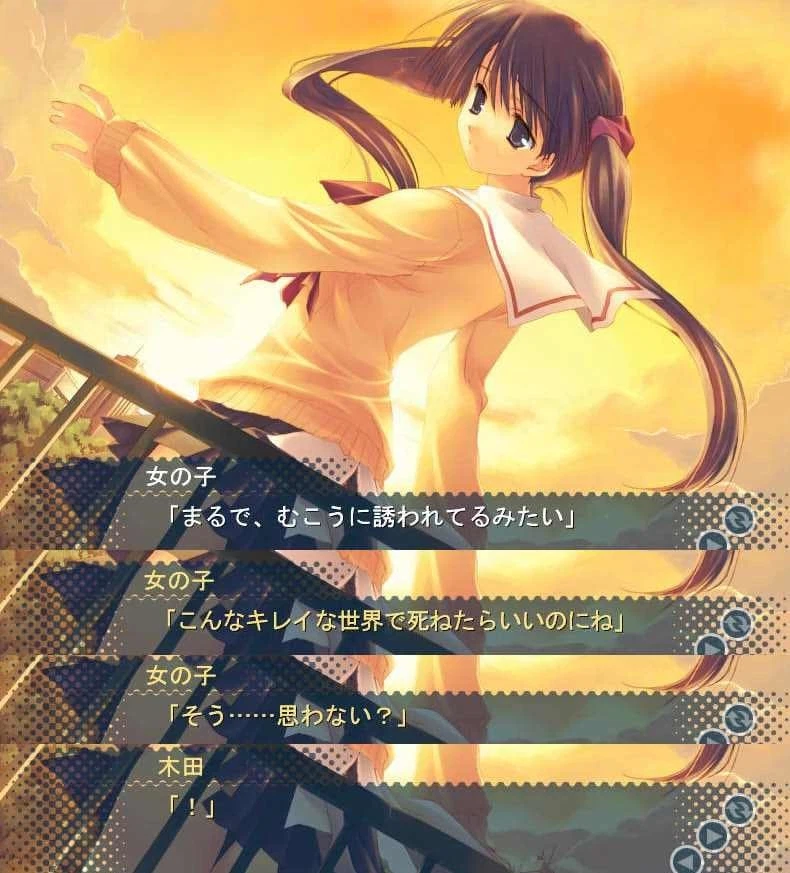
“It’s like something over there is calling me.”
“If only I could end it in a world this beautiful.”
“Don’t you… think so?”
Protagonist "!"
Sensing that he’s freaked out by what he’s seeing, Sumadera immediately follows up with a poem-combo and presses the advantage. She even finishes with a neat little question at the end—like she’s fully enjoying herself. The way she gets more and more emboldened the more the other person flinches… it’s weirdly realistic.
And the protagonist’s “response” is literally just: “!”
He’s basically a silent JRPG protagonist—SMT, Dragon Quest, that whole bloodline.
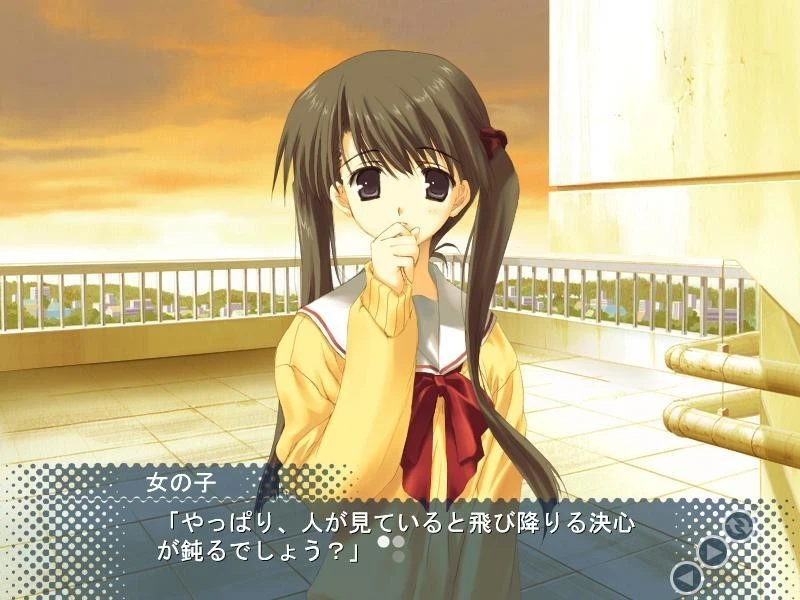
“Having someone watch makes
 it harder to go through with it,
 right?”
Once she’s said all the poetry she wants, Sumadera abruptly cancels the whole “stepping off” thing like it was just a switch she flipped.
That incompleteness—this not-quite-fully-formed instability—is exactly her charm. Early on, she’s packed with painfully adolescent lines like:
- “Maybe I’m not even real.”
- “I don’t have emotions.”
And that’s how this strange encounter begins: an unstable girl and a soft-delinquent guy.
・Emiri
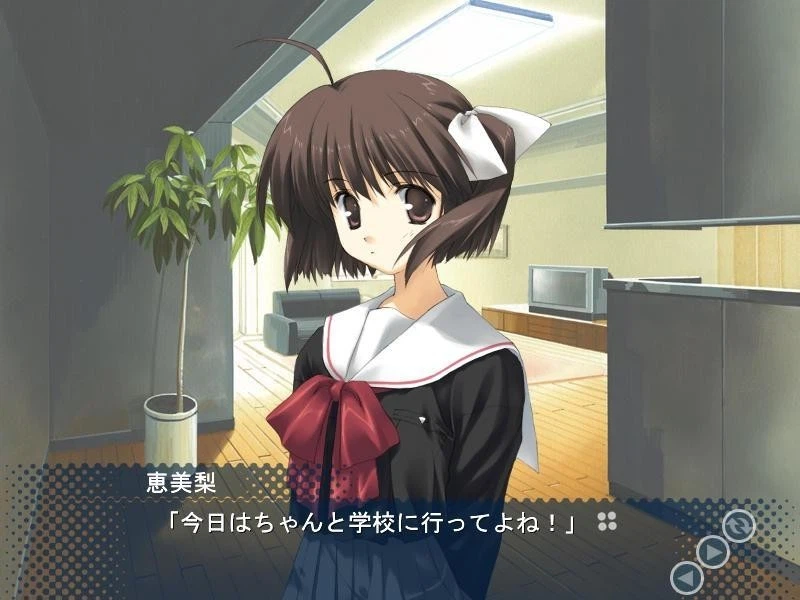
Let’s switch gears for a moment. This game also has an unromanceable little-sister heroine named Emiri.
At first glance she looks cute, but she’s not the “unconditionally loves her brother” sweet little-sister type at all. If anything, she genuinely can’t stand him, in a very teenage way. In a visual novel, no less.
Through various events, the protagonist ends up keeping a puppy at home. Emiri sees it and lightly snarks at him—like, “You’re gonna eat it or something?”—just a casual jab.
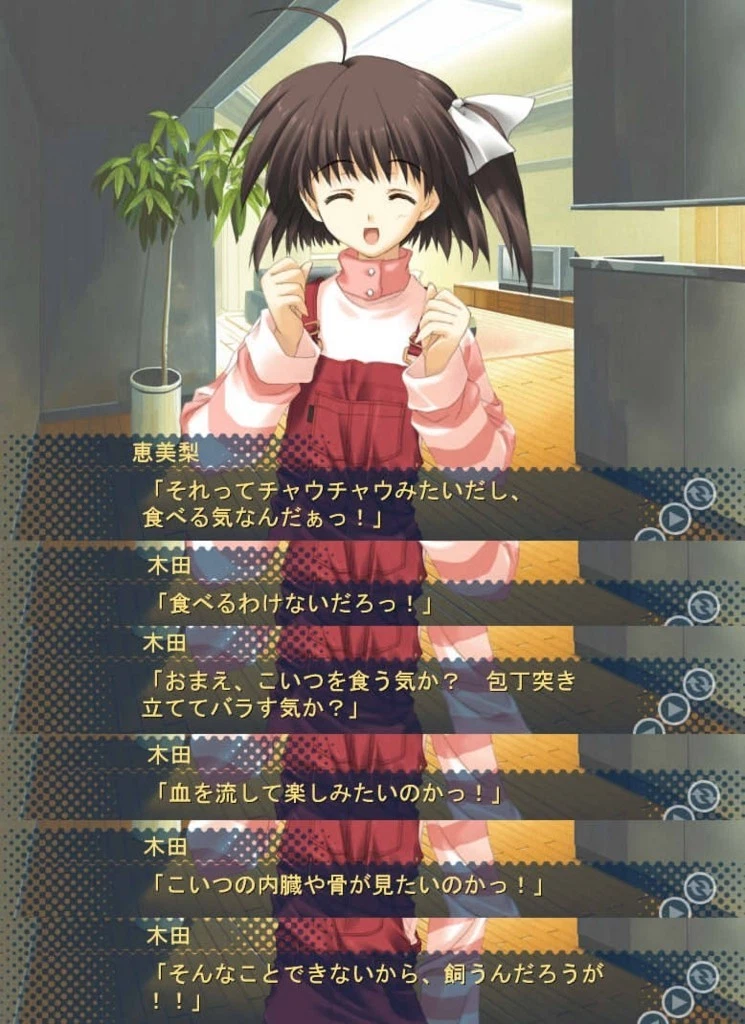
And then the protagonist suddenly blows up, screaming something like, “You want to see blood and enjoy it?!”
The instant he thinks he’s on the “righteous side,” he goes full aggressive prosecutor—basically the internet in human form. Forget “siblings not getting along”—this personality flip is just plain unhinged.
Even Emiri, who’s usually the one mocking him, ends up crying… which is fair, because when your actual brother goes as far as saying “You’re the one who should get torn apart” level stuff, yeah. Anyone would break.
This game is packed with nothing but lunatics.
・Yukio Sumadera and Emiri
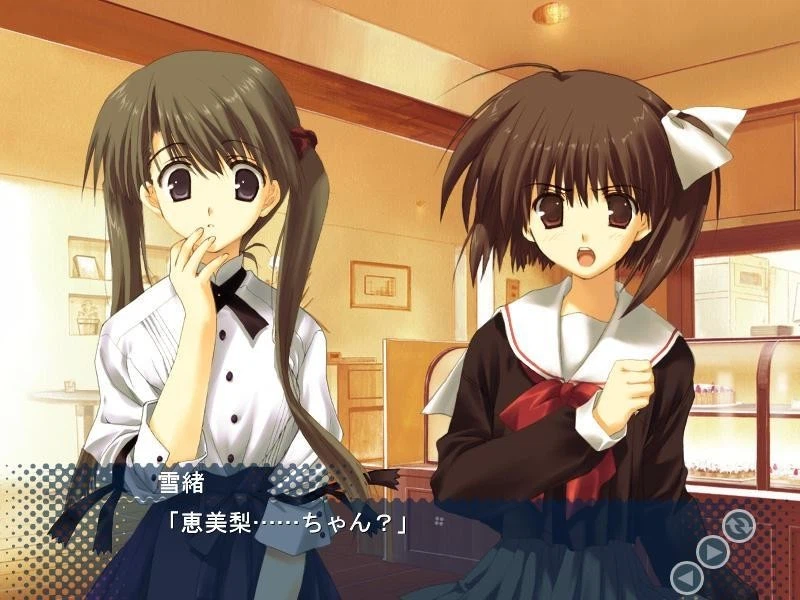
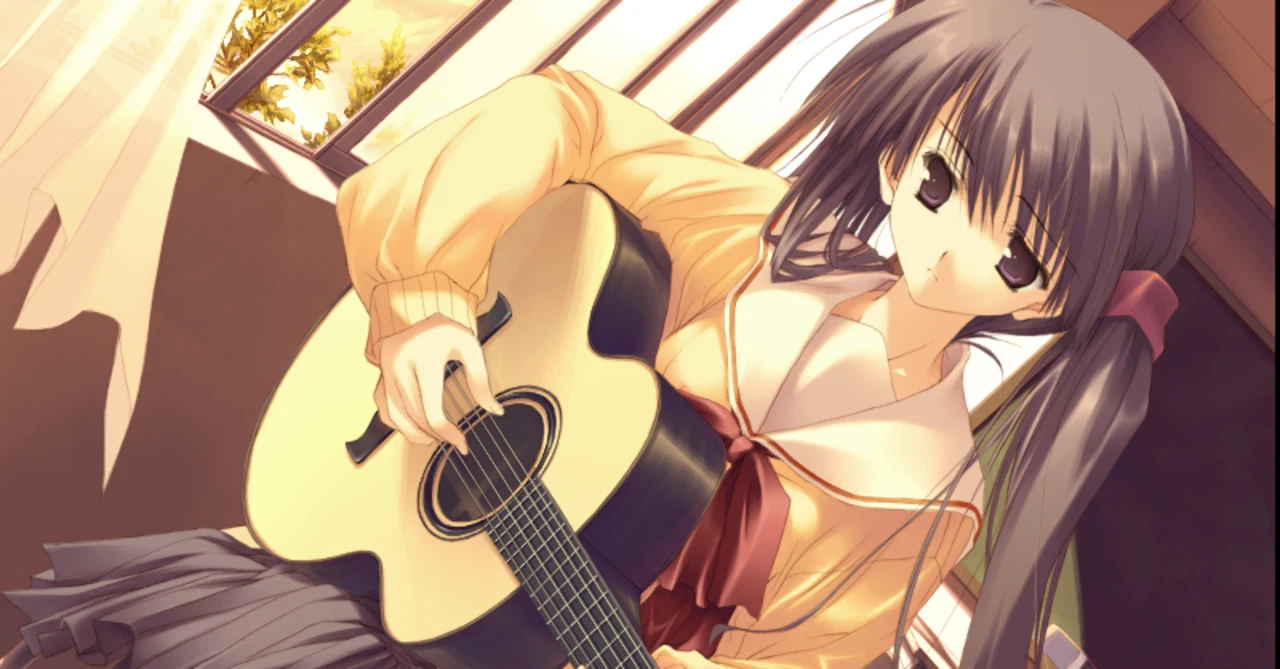
Emiri also happens to know Sumadera—and she’s even fallen for her, watching Sumadera play guitar alone in the classroom.
Outside of Suma-dera’s route, there’s basically no hint that Emiri is into girls—so when it suddenly comes to light, players are just left going, “Wait, what?”
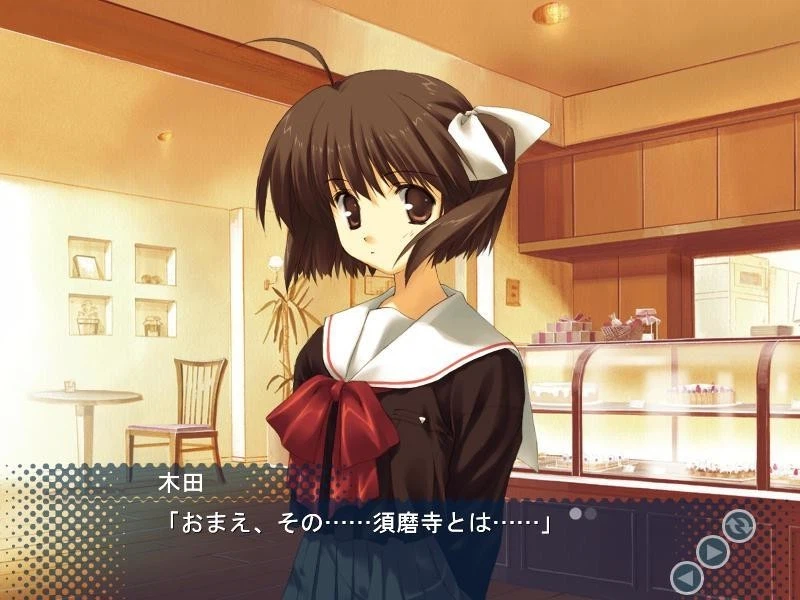
Normally in this situation, you’d expect the protagonist to be clueless and dense about it, right?
But this protagonist notices it almost immediately—just from a slightly close distance between them—and confidently declares it as Emiri’s feelings. That pushy certainty honestly makes you wonder if the protagonist himself is a full-on yuri-brained guy.
And that relationship between the two of them eventually turns into a much bigger problem…
・A rare heroine who becomes a “casual partner”
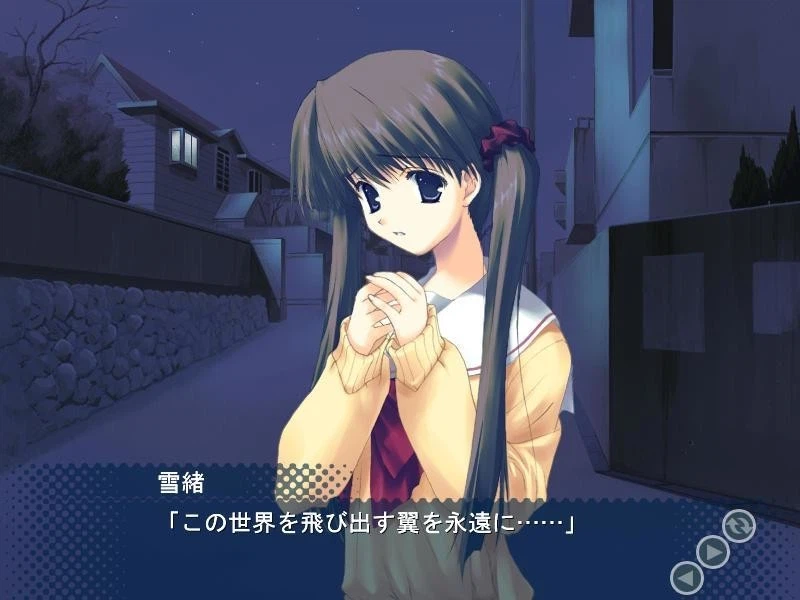
“Wings to leap beyond this world… forever…”
By coincidence, the protagonist ends up working part-time at the same place as Sumadera.
After their shift, they walk home together—and the moment they’re alone, Sumadera fires off another original poem. The kind of person you’d run into back in the old Skype-channel days.
Then she makes a proposal: basically, “Don’t spread what you saw in rooftop—let’s settle this with something physical.”
It’s such a dangerously wild suggestion you can practically hear players falling out of their chairs.
And the protagonist’s reaction is also insane.

“Run away because I’m scared.” or "Surrender to my body's reactions"
You even get a choice like “Run away because I’m scared.”
The other option is way too driven by lust. And what’s missing entirely is the normal option: “Politely refuse and go home.” That thought doesn’t exist in this universe.
The “correct” choice is the second one.
goes straight to a hotel anyway.
And if you pick “Run away,” he screams “Uwaaaaaa!!” and bolts without understanding anything, instantly getting a game over. Even Sumadera—who claims she has no emotions—would probably be shocked by that.
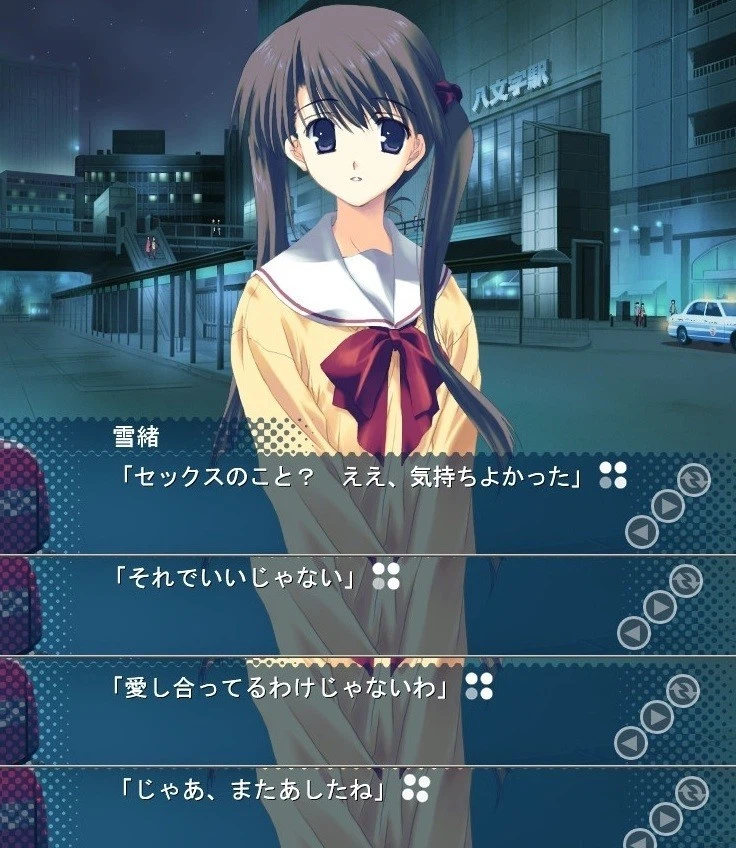
“Yeah. That felt good.”
“And that’s fine, isn’t it?”
“It’s not like we’re in love.”
“See you tomorrow, then.”
And so, congratulations: the two of them end up in a rare-for-a-story-focused VN relationship—basically casual, physical-only.
After that, Sumadera repeatedly pushes for it whenever she feels like it, showing you, over and over, just how much she’s the “explosive, dependency-driven” type.
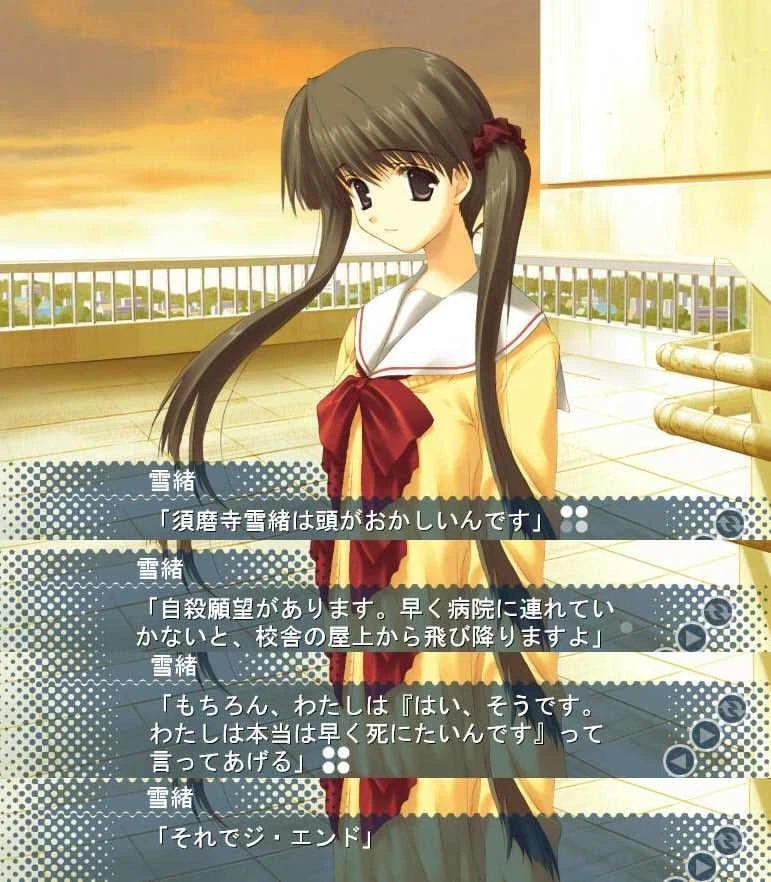
“Yukio Sumadera is out of her mind.”
“If you don’t get me to a hospital soon,
 I’ll jump off the roof.”
They keep stacking up a relationship that’s supposedly “only physical,” and yet their distance still undeniably closes.
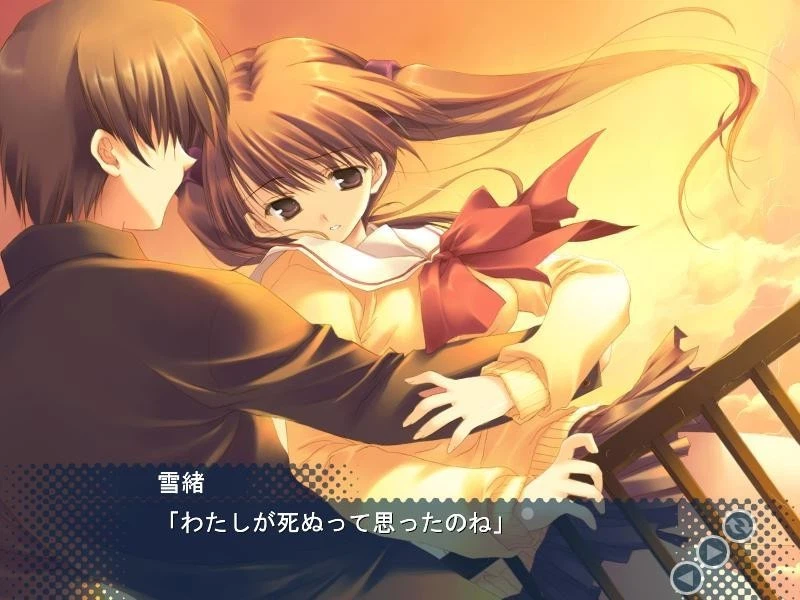
Sumadera steps over the safety fence knowing she’ll be stopped—testing.
The protagonist takes the test completely seriously and responds earnestly.
The fact that a dynamic like this was depicted in a bishoujo game around twenty years ago is honestly kind of insane.
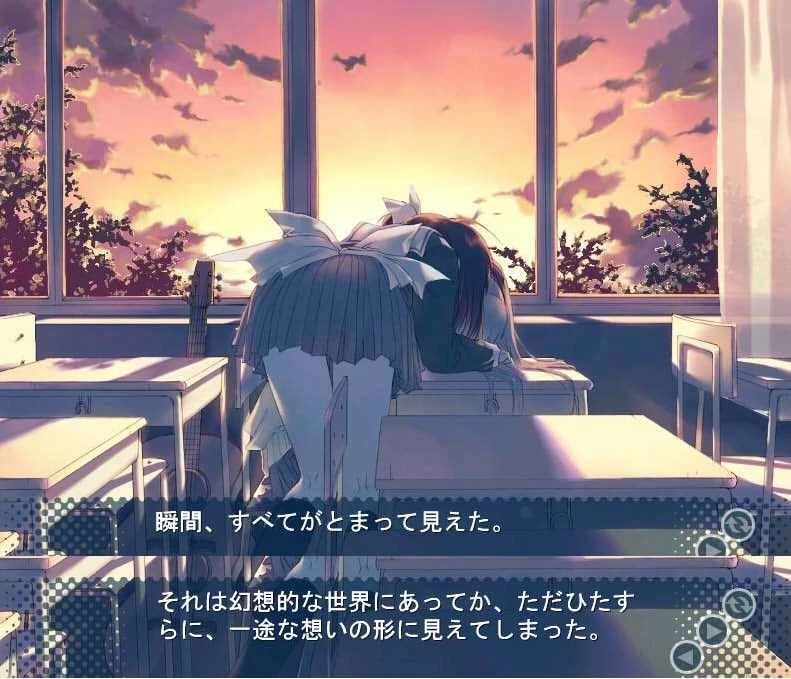
One day, the protagonist witnesses a scene where Emiri can’t hold herself back anymore and forcibly steals a kiss from Sumadera. The CG is genuinely beautiful.
And right in front of his little sister’s outburst, the protagonist starts spouting yuri-poetry like, “In this fantastical world…”
Yeah, he’s probably yuri-brained.
But Sumadera is into guys, so she rejects Emiri’s feelings. Emiri runs off in tears.
・Emotions, returning
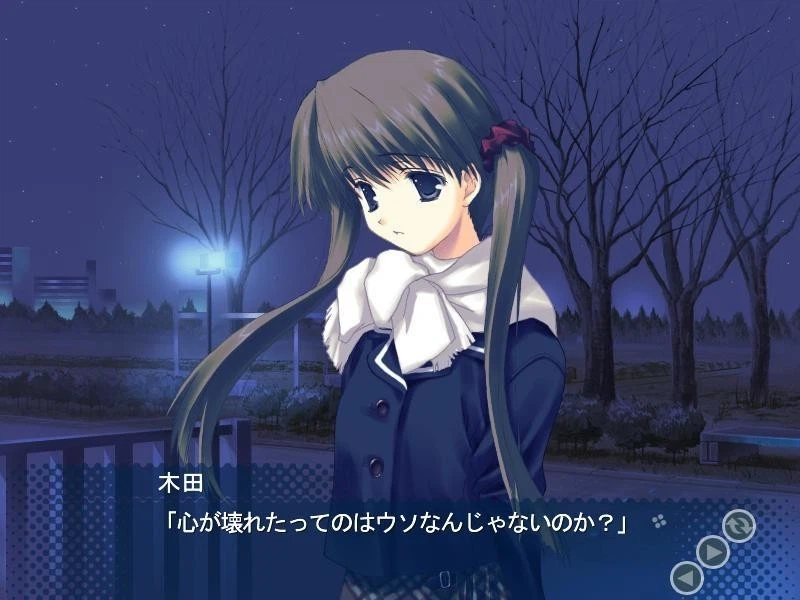
As days pass, even the protagonist—who had zero tolerance for an unstable girl—starts realizing that Sumadera does have emotions after all.
In response, Sumadera explains her past: ever since the day the big dog she loved—like a little brother—died, she “lost” her emotions.
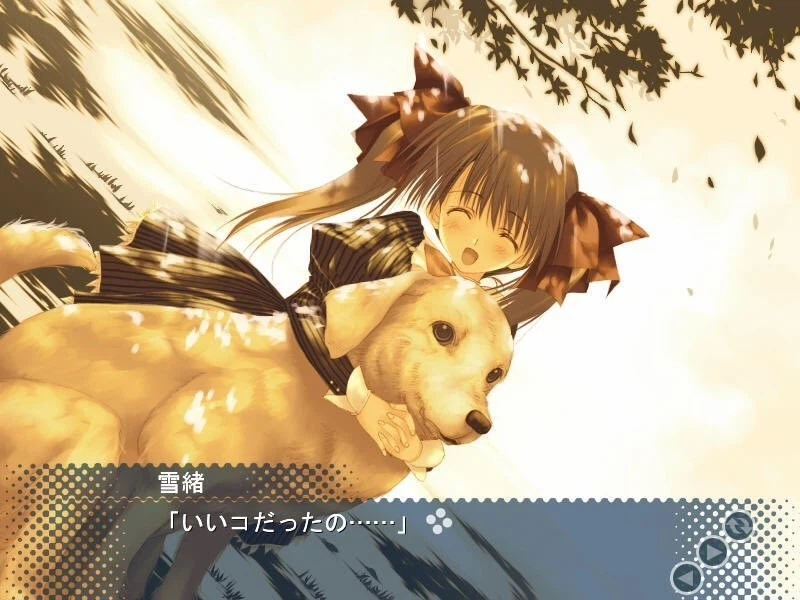
(And by the way, that huge dog has a face that looks even more emotionless than she does.)

She says she’s terrified of losing something precious again, and that fear is why she instinctively pushed Emiri away when Emiri confessed.
And then she escalates:
“If my emotions come back, I don’t deserve to live,” she says—twisting herself tighter and tighter.
“ I don’t want to be hated. I don’t want to lose anything.”
And because she’s cute, she starts throwing out more and more convenient lines—weaponizing vulnerability in the most adolescent way possible.
The protagonist, fully contaminated by the co-dependence, says something like:
“If you’re going to disappear, then I have no reason to live either.”
And he proposes, “Let’s go together.”
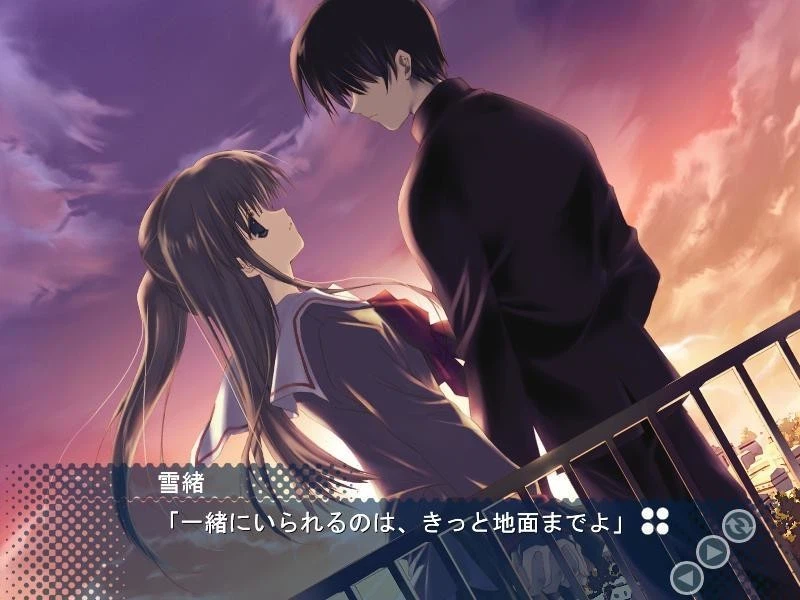
“We’ll only be together… until we hit the ground.”
The day of it. The usual rooftop at dusk.
Only at the very end do they do it “like lovers”—and then, so they won’t separate, they tie their hands together with a ribbon… and step off together.
Up until now, their relationship was all surface-level physicality. But through “death,” emotions finally overlap too—like the physical and the emotional fuse into one.
And that young, unstable girl and the soft-delinquent guy throw themselves into an extraordinary moment—answering, in the most reckless way possible, the adolescent struggle over what life even is.
What a beautiful—what a terrifyingly beautiful—scene.
As I said earlier, this work is full of heroines who mess up in very “that age” ways—twisted pride, wrong turns, ugly feelings. December When There Are No Angels is a one-of-a-kind classic that digs into the hunger for validation and the darkness in the heart—born in an era before social media.
And among it all, Sumadera Yukio’s route—centered on a fragile, too-young inner world that leans hard into “death”—is wrapped in a delicate beauty that doesn’t fade, no matter how many years pass.
Comments (1)
Leave a comment