


Lately, one of the things I keep wrestling with is what I call “chosen good.” That’s just my own simplified phrase for it, not some real established concept.
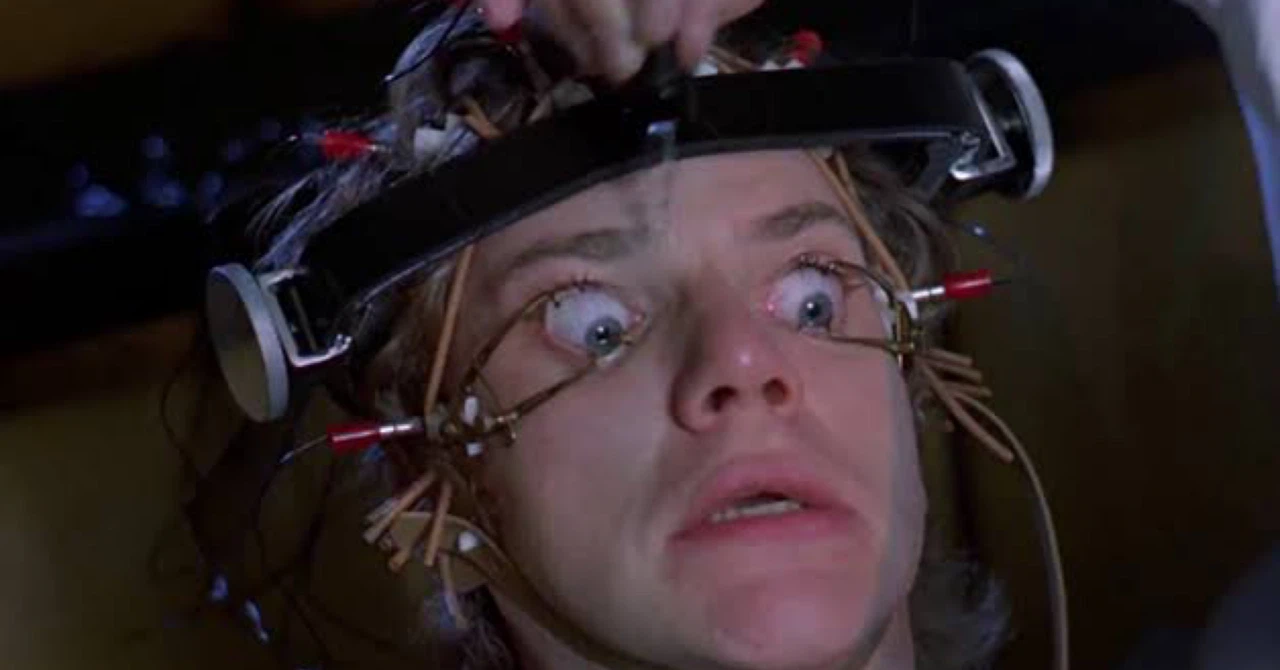
An easy example would be A Clockwork Orange.
To pull out only the relevant part: the protagonist, an utterly terrible delinquent, is subjected to the brutal experiment known as the Ludovico Technique, which alters him so that whenever he does something bad, he’s overcome with nausea. Since his body rejects evil, he’s forced to live as a “good person,” and from the government’s perspective it’s a fantastic success—violent criminals can be rehabilitated so easily! But in the middle of the story, the prison chaplain talks about “good.”
He tells the protagonist, “Goodness is something one chooses. When a man cannot choose, he ceases to be a man.” That idea sank so deeply into me that I filed it away in my head under the name “chosen good.” The protagonist, turned into a “good person” by an experiment, is not actually choosing to do good himself. He simply has no other option. Good done without thought has no meaning, and something like that is not even human—that is the moral view this devout chaplain holds. An animal that stops misbehaving because it will be scolded has not become good; it is only instinctively afraid of humans. If so, then the protagonist after the Ludovico Technique is an animal too.
I really love what that chaplain says.
For people like me, who hated compulsory education with all my soul, maybe school feels so intolerable because it’s a place built on this “chosen good.” Of course, if you want to impose order on unruly elementary and middle school kids, you have to present the rules before the reasons, and enforce a certain amount of coercion and correction. So anyone who breaks the rules is judged in class meetings. “Whether the rules themselves are right or not” is considered too advanced a question for children, and what gets rewarded instead is surface-level good behavior. That cramped feeling is exactly what I can’t stand. It feels like being grabbed by the throat by faith in education and forced to face it.
Still, structurally, that can’t really be helped. If you want absurd little children to sit at desks, the fastest way is to establish rules and punishments, and rank them by how well they follow them. When there are a lot of people, order takes priority over everything. If that doesn’t suit your skin, it really doesn’t suit your skin. At least now we live in a time when, if you truly hate it, you don’t have to remain trapped inside compulsory education alone. Though that path is its own kind of hell.
As an aside, the atmosphere of the internet is built on the order created by the majority, so what counts as “good” keeps changing from moment to moment. People shift their ethics either to avoid being attacked or to make it easier to attack whoever annoys them, and so everyone, for the time being, “chooses good.” In other words, it’s a nonstop chain of choosing-good. But lately, maybe people have started to realize that there’s no real meaning in living like that—or maybe the suffocating feeling itself has become more unpleasant—because I feel like more people are acting without bowing to the internet’s peer pressure. That’s wonderful. Maybe the influx of smartphone-era young people rewrote the existing order all at once. I prefer chaos anyway, and I want to see the moment when new heroes arise out of chaos and repaint values and morality. The Swell of an Era, and the Dreams of the People
Anyway, whether it’s school or social media, once the population gets large enough, binding people with rules is unavoidable. I take that as a given. On an even larger scale, religion too is a mass of order. Within that, by taking the teachings as a starting point and then truly beginning to think about good for yourself, you become human. For children who don’t know left from right, some guiding standard is necessary at first. But if you go on living by nothing more than that forever, then you are not choosing—you are living in a world of chosen good.
There are plenty of similar things in ordinary social life. Really, society itself is nothing but order. That’s what makes it suffocating for me. Since releasing a game, my relationships with other people have increased, and I’ve had no choice but to participate in society. It is what it is. But if there’s one thing I want to avoid most, it’s having good chosen for me. That’s why I write thoughts like this in my diary, and at the very least, I’ve stopped using polite social niceties and fake smiles. Every time I say something merely to preserve the atmosphere of the moment, it feels like my soul gets a little dirtier, so I quit. I don’t go to drinking parties either, because once there are too many people, I end up spoiling the mood. But in small meetings, what matters most is the strength of what we’re making, so honest opinions are appreciated. If something feels weak, being able to say, “Sorry, but let’s redo this part,” or hear that from someone else, is a relief.
In any case, because I understand my own troublesome nature better than anyone, I want to be free above all else. And within that freedom, the ideal life would be one where I can choose for myself what I believe is best. Even if that “good” looks like ordinary evil to everyone else, I don’t care. Because what matters is choosing.
I never thought I’d end up agonizing this much over a single lesson from the chaplain in A Clockwork Orange. But I like thinking in circles about good and evil and ethics like this. I do it because I like it, so if someone thinks this gloomy, hesitant hobby is ridiculous, I hope they charge ahead with all the brightness they were born with. That liveliness is one possible answer too, and I like it. In the end, I’m just the kind of person who does what he likes and thinks what he likes. In that sense, I’m the same as Alex. Maybe one day I’ll end up needing the Ludovico Technique myself.
Comments (1)
Leave a comment