

Even after you’ve managed to publish a book commercially, you still have to keep fighting a mountain of complexes and anxieties before you can truly admit to yourself that you’re a writer. Your final “anti” is yourself.
It’s that voice inside that never stops asking: “Have you really devoted yourself to art enough to call yourself a writer?”
Before William S. Burroughs is a great novelist, he’s a junkie. His psychedelic way of living gave birth to the so-called “cut-up” method: slicing up the structure of a story and reassembling it into a single book, creating a trip-like technique overflowing with chemical charm as delirium spills out from the seemingly nonsensical text.
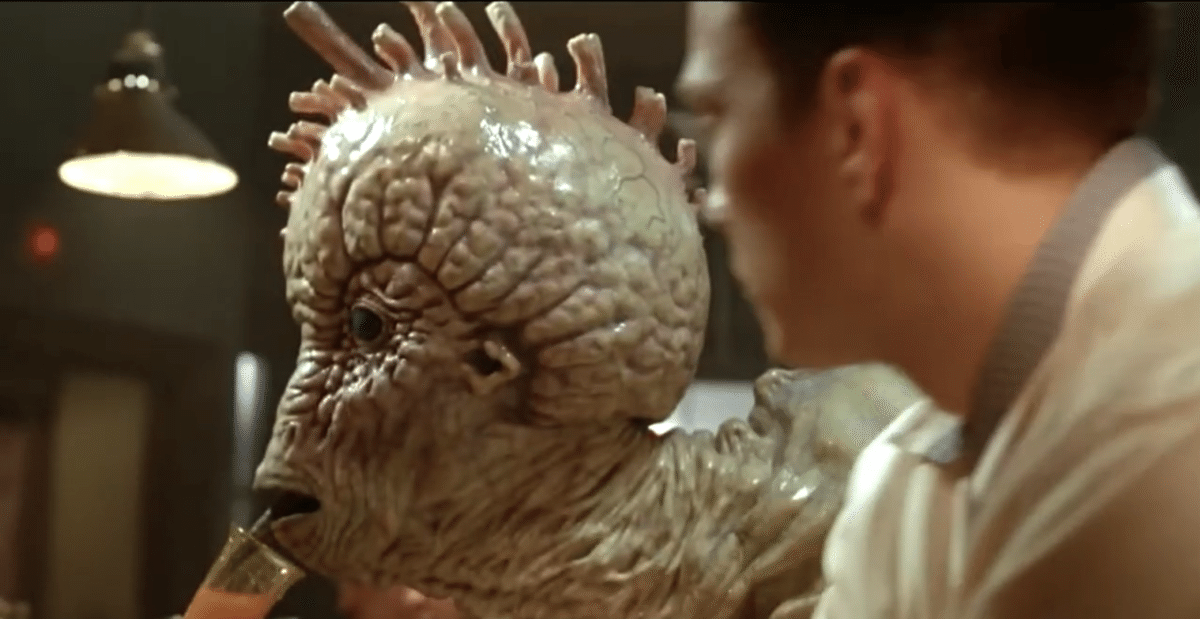
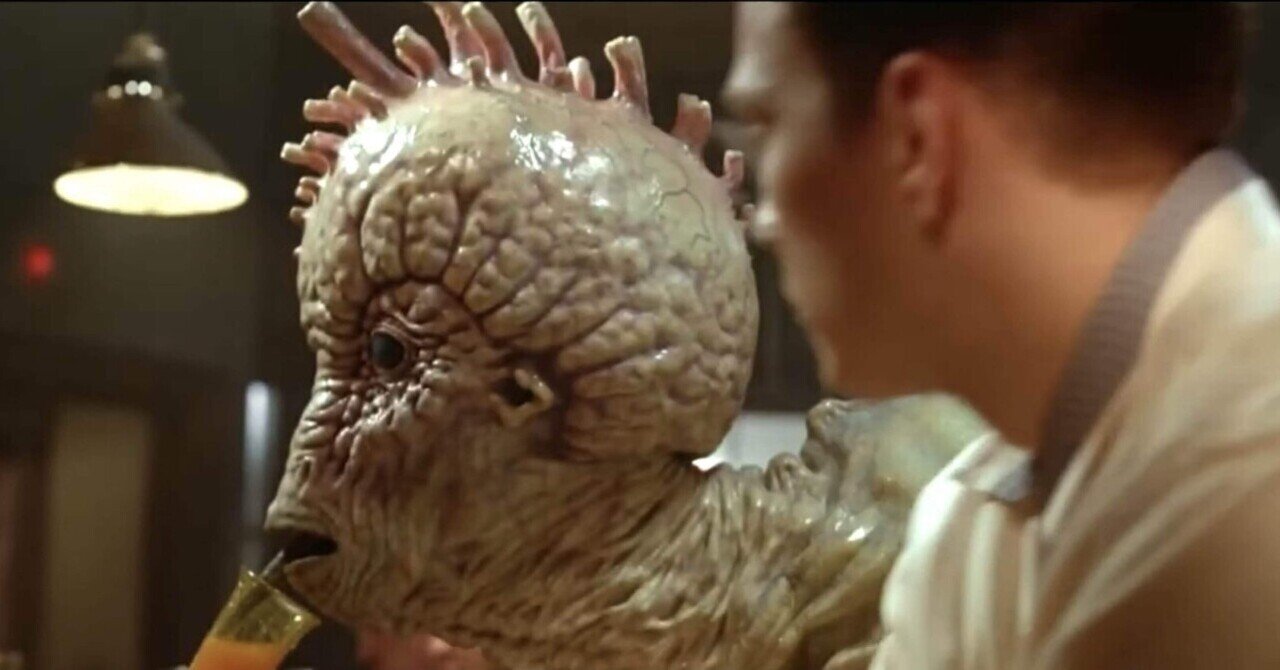
David Cronenberg takes the eerie scent of Naked Lunch’s original novel more or less as it is, and then trains his camera on William S. Burroughs himself. In a sense, it’s a cruel yet honest film adaptation made from the perspective of a fan.
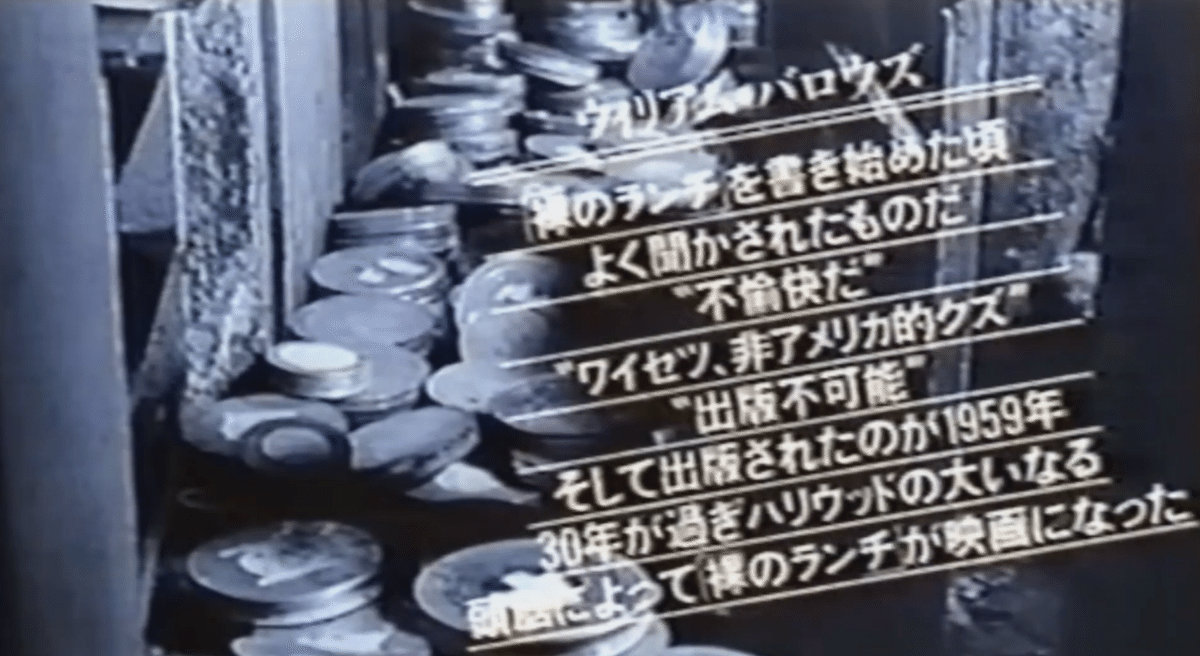
Cronenberg’s appeal lies in his bizarre worlds and monsters that lure you in with their grotesqueness. He overlays Burroughs’s self-consciousness onto this absurd “weird book” called Naked Lunch.
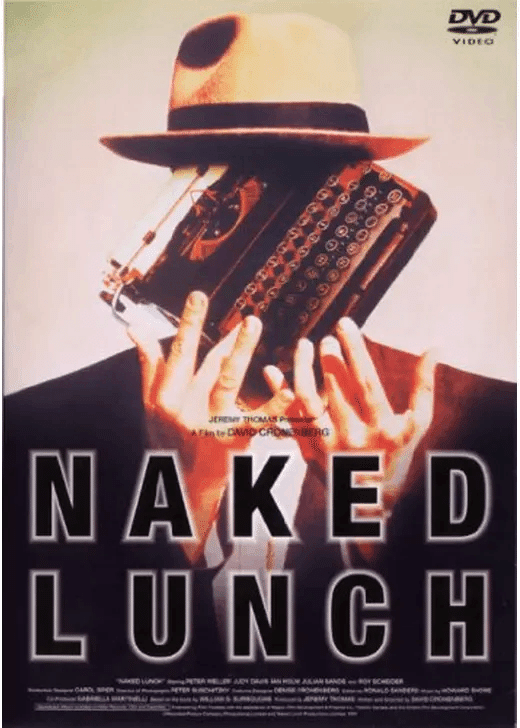
The key item in the film is the typewriter.
The protagonist keeps tripping on roach powder he ingests, and in that state, he talks with a monstrous typewriter as if it were his partner.
No matter what happens, he’s always together with his typewriter: it gets stolen, he takes it back, it powers up. Through this, you understand that his very identity is rooted in being “a writer.”
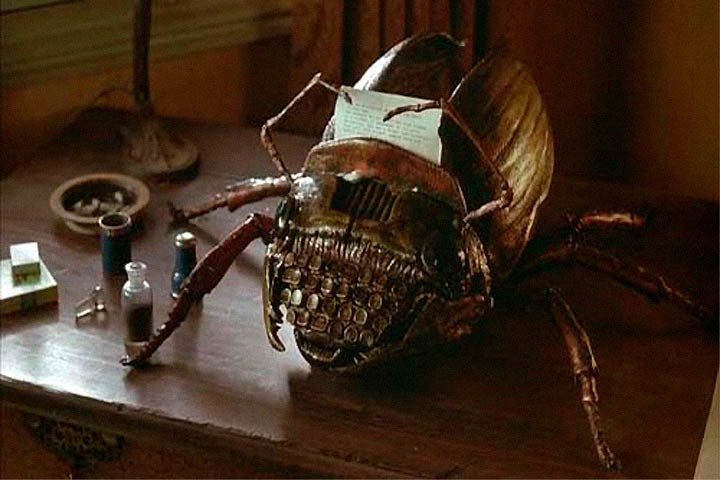
A cockroach-shaped typewriter. A creature like that ends up filling the Pikachu-like “partner mascot” role. In other words, for the protagonist—and by extension for Burroughs himself—no matter how deep he sinks into hallucinations, he refuses to let go of at least one hope: that his own writing has value.
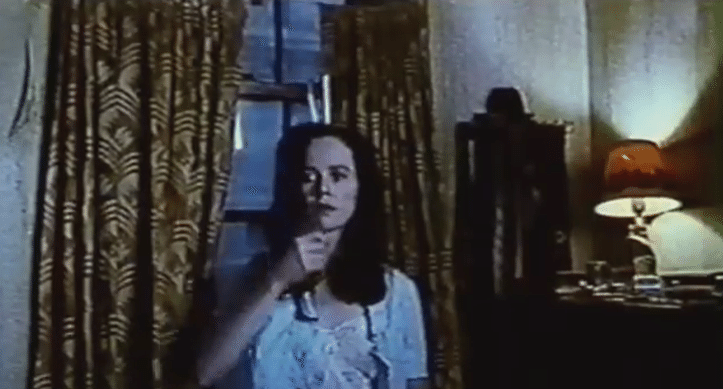
In the film, the protagonist accidentally shoots his own wife to death.
This episode, of course, is Burroughs’s own.
Burroughs and Joan Vollmer lived in New Orleans for a time. Later, looming divorce issues became a problem between them. He moved to Mexico City in 1949, where he ended up shooting and killing Vollmer and was subsequently held criminally responsible. His account of the incident has changed multiple times. Vollmer was only 28 years old at the time.

The blazing self-consciousness he must have felt after shooting his own wife.
The junkie days drowned in drugs, the state of his mind.
Both Naked Lunch’s protagonist and Burroughs himself never give up writing, no matter how much they drown in smoke and white powder.
Even if his book is condemned as obscenely filthy and banned. As an aside, this outlaw way of living is part of what later shaped Kurt Cobain.
But a junkie is still a junkie. Even if some of his eccentric novels were adored by a handful of freaked-out hippies, he must have agonized over how much of that came from “real ability.” Was he just a strung-out druggie who banged out a book and got lucky on sheer momentum, or an outsider artist who managed to subsume even his filth into his writerly persona?
Madness and art. Sin and forgiveness.
By relentlessly dissecting his own interior and writing out his guts as text, he painfully reconstructs his grotesque inner world on the page—and in that, there’s a kind of Kafkaesque beauty.
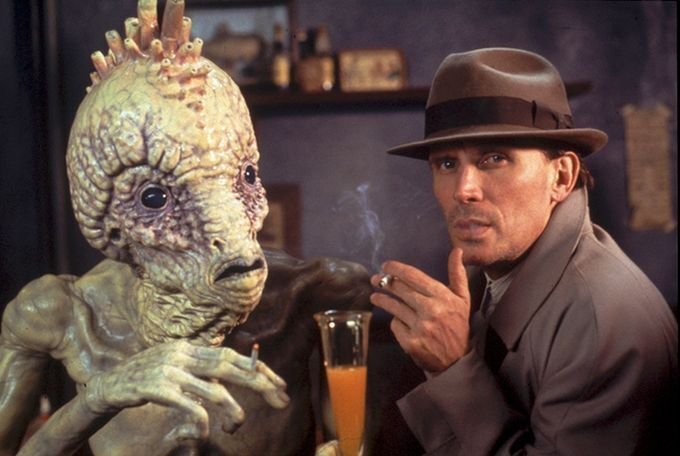
Can a writer truly accept themselves as a writer? For all its psychedelic imagery, the Naked Lunch film is, at its core, a straightforward journey through a very narrow circle of self-consciousness. Junkie, artist, or just a misfit. Or a being made up of all of the above.
Near the end, the protagonist is stopped at the border and ordered to “prove that you’re a writer.” He responds by once again shooting his hallucinatory wife and receives permission to pass. The moment he decides to transmute the unique tragedy of “having killed his own wife” into creation, he’s already stepped through the gate into being a novelist who has given his life over to art and literature—no matter what anyone else may say.
Comments (1)
Leave a comment