


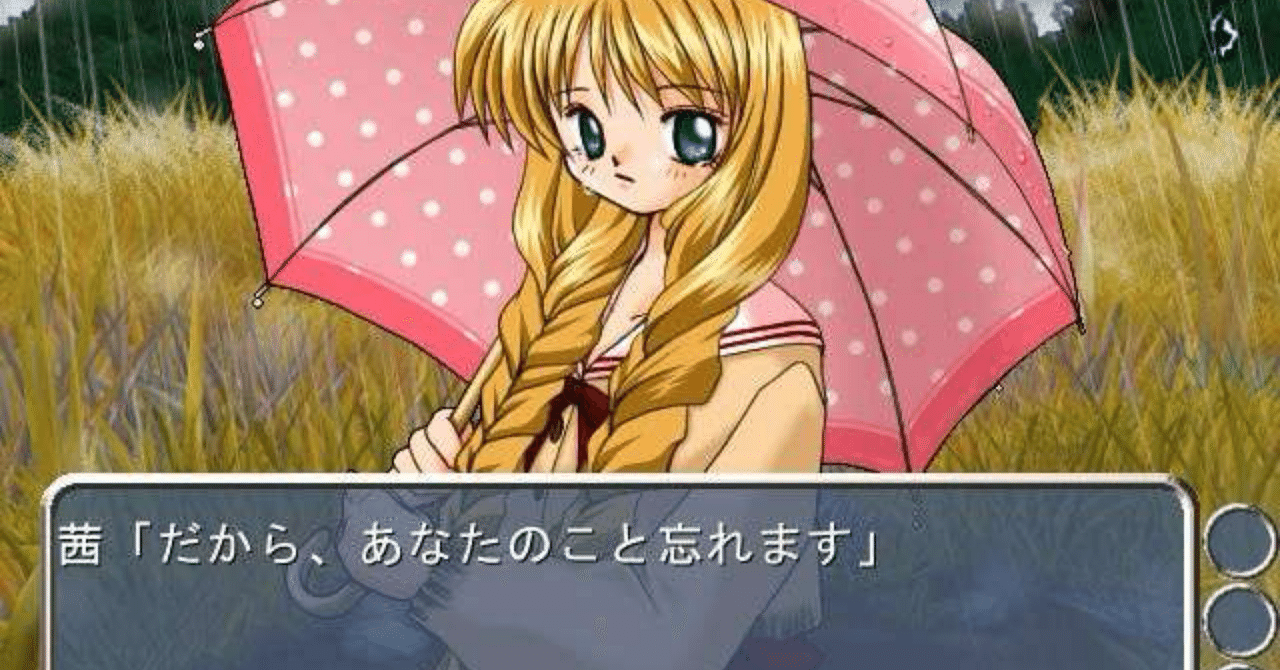
A remake of ONE has finally been released—more than twenty years later. And I want to talk about one of its heroines: Akane Satomura. Because I love Akane Satomura. I love her—so, so much…
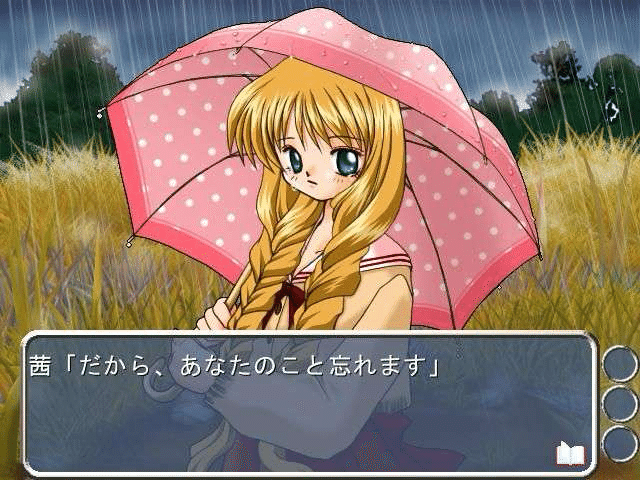
Everything about the art is incredible.
Itaru’s shoujo-manga-esque character design, paired with that still-unripe, groping-for-it quality (in the best possible way), matches perfectly—and gives her a miraculous air of unstable girlhood. Even a single standing sprite already carries her fragility.
And that BGM—“Rain”—that plays over this screen… it’s perfection. Absolute perfection.
Honestly, I still prefer ONE’s original art style. Not just ONE—I’m the kind of person who loves older resolutions and even the clunky systems that came with them. So if anything, I want people to play the original rather than a remake or remaster. I even talked in an interview about how “the immersion comes from the hassle of swapping discs.”
That said, being able to play it easily on a modern setup, with a simpler and more comfortable system, is obviously a good thing. My preferences are just the complicated obsessions of a troublesome otaku—so everyone else should simply pick whatever you’re curious about, or whatever’s easiest to get your hands on. “I suffered through a hard system, so the younger generation should suffer too” is, sadly, nothing but peak boomer brain.
Though, to be fair, the PS version port of ONE was awful. A heroine was clearly slapped in with zero care, and the presentation shifted from a text window to full-screen, completely changing the texture of the experience. The light, snappy, comedic back-and-forth with the heroines is absolutely one of the two writers’ strengths—so it’s a shame to lose that tempo just because the screen is darker and the text placement drags the rhythm.
Ports and remakes can sometimes change a game’s entire impression, so I do recommend looking things up beforehand.
Anyway—back to Akane Satomura. Her route is good. This was before “tsundere” was even a solid concept, so she isn’t really tsun so much as… a shadowy girl who rejects other people completely. The protagonist—a cheerful, meddlesome type—keeps poking at her because he can’t stop thinking about her. She eventually gives in, little by little, begins to trust him, and their conversations grow longer. It’s so straight down the middle that it feels almost impossible by modern standards. You gradually learn the dark past and conflict that led her to avoid others—and it’s presented without any cheap cynicism, just… placed in front of you, sincerely.
Because it was an era when the very idea of “making players cry with a scenario” was still an oddity, it could produce something like this: a perfectly sharpened raw gem of a nakige—a “crying game,” designed to move you to tears. Even playing it in the Reiwa era, that pure shine still glows without a single speck of cloudiness.
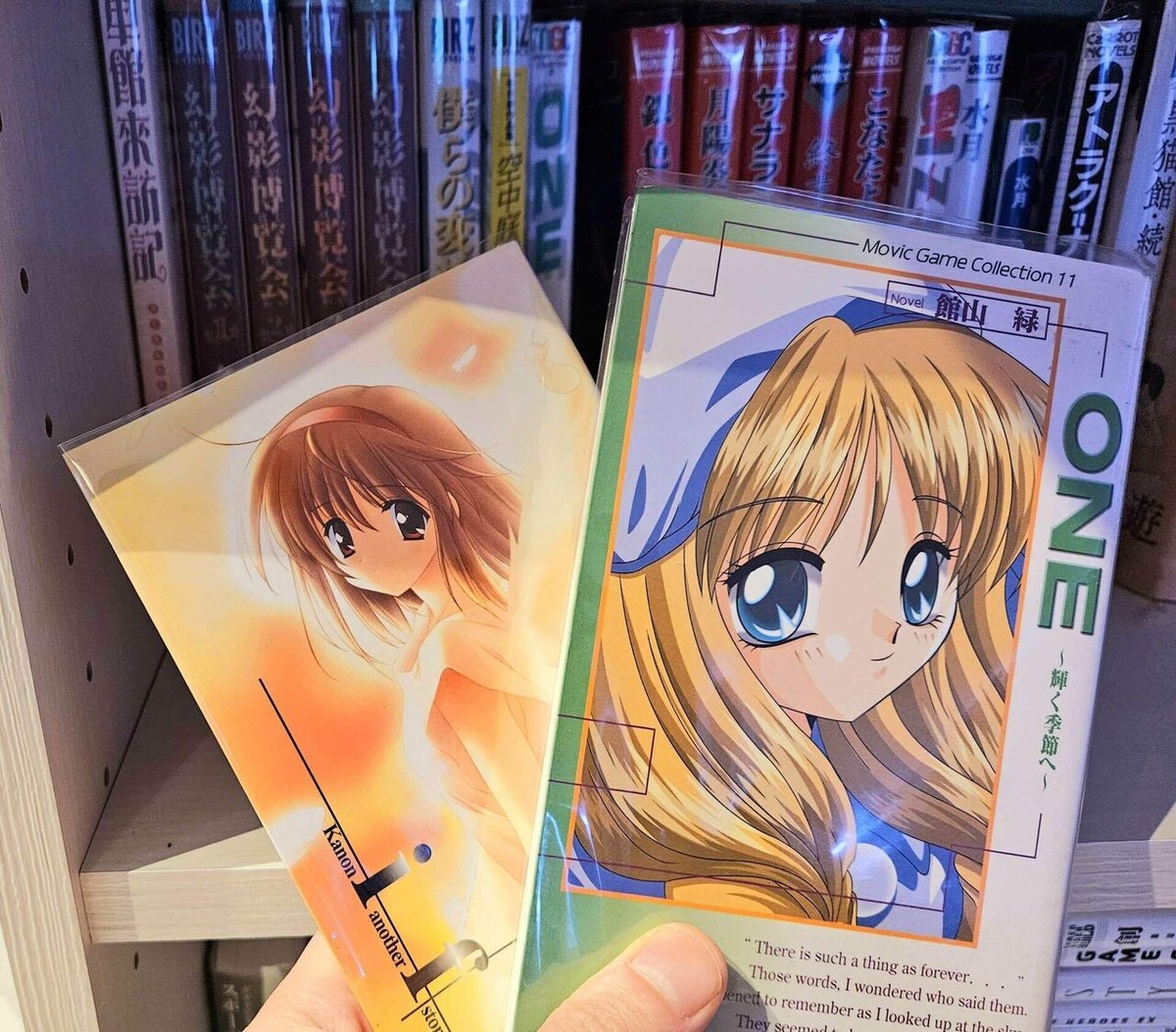
The “novel version” approach to Akane Satomura’s story is fascinating too. On the left is a Kanon doujin novel by Naoki Hisaya—who wrote Akane’s route in ONE (and also Ayu’s route in Kanon)—which I happened to find today while wandering Nakano Broadway. In both ONE and Kanon, the routes I loved most were written by Hisaya. Of course, that’s after fully enjoying Jun Maeda’s scenarios too. It’s easy to understand why Maeda still carries a complex about Hisaya even now.
As I said, I think Akane’s scenario is “pure” in the sense of being a true origin point for nakige—yet the novel version goes even further and is written from the heroine’s point of view. A girl who has thoroughly avoided the opposite sex slowly finds herself drawn to an overly helpful male student… it’s pure shoujo manga.
That girlish, romantic psychology—I decided I mustn’t fall in love, and yet I’m starting to soften, and I don’t know what to do with this… but I can’t help hoping—is something you simply can’t get from the standard bishoujo game experience, where you “play as the protagonist to capture the heroine.” When adapting it into a novel—a form that doesn’t need other heroines to exist—if you’re going to write such a perfect romance with a delicate, fleeting, unfortunate beauty, maybe you can’t help but want to depict her fragile heart directly.
Akane Satomura is just that pure.
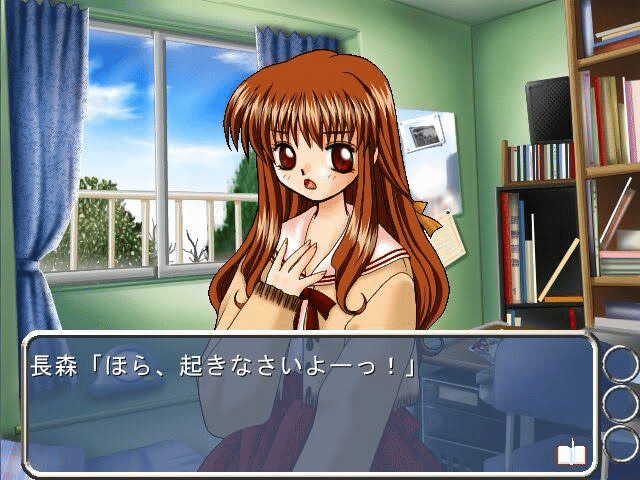
I’ll keep this short since it would derail the topic, but ONE is overflowing with other wonderful heroines too. Jun Maeda’s archetypal childhood friend, Mizuka Nagamori, is so purely “childhood friend” that it almost feels fresh again—yet the actual content of the scenario is still strikingly bold even by modern sensibilities, unfolding into a story of “a man’s testing behavior and a woman’s devotion.” Nagamori’s route is the kind of ambitious content that would genuinely make fans angry today (it left a strong impression on me, and I loved it), so I hope you experience both.
Once again: a work that’s one of the origins—and one of the peaks.
Comments (0)
Leave a comment
No comments yet. Be the first to comment!